// NATURE NEWS — SPAZIO & SCIENZA
Butterfly wing patterns in flight create powerful illusory motion cues
Nature
(2026) Cite this article
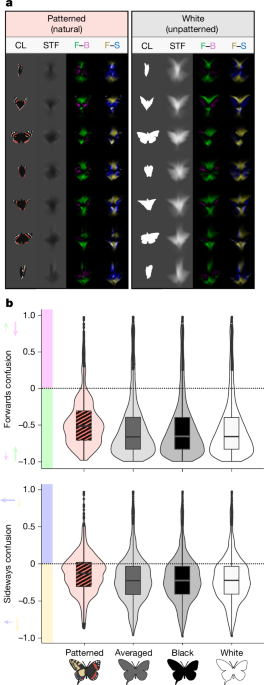
The dazzling stripes found on zebras and snakes have long been thought to interfere with predator motion perception1,2, but this hypothesis has received little empirical support so far3. Butterflies show enormously diverse and high-contrast wing patterns, the function of which has inspired intense theoretical debate and research4. Here we suggest that butterfly wing patterns work in tandem with flight dynamics to create visual illusions that confuse predators. We use multiple lines of enquiry with biologically inspired modelling to support this hypothesis: free-flight butterfly take-offs filmed at high speed demonstrate the creation of misleading motion cues; phylogenetically controlled analyses demonstrate that this is an evolutionarily widespread strategy; in silico evolution experiments independently converge on high-contrast butterfly-like wing patterns; and behavioural experiments validate model predictions. Our results show that butterfly wing patterns and flight dynamics create powerful illusory motion effects, potentially representing one of the most successful visual defence strategies in moving animals.
Movement can break even the most effective camouflage5,6,7,8, rendering almost any animal highly conspicuous. Animal markings have evolved to exploit limitations in the vision of their predators, and this principle should hold true for animals in motion, where patterns have long been thought to interfere with a predator’s perception of the speed and direction of their prey via ‘motion dazzle’ effects3,9. High-contrast stripes and patterns are known to create illusory motion8,10,11, but studies testing their effects in animals such as zebras, snakes and lizards have been somewhat equivocal in their support1,2,12,13,14. Importantly, these studies exclusively used rigid prey, despite animal locomotion often requiring limb movements that oppose the body’s main direction of travel. Biological motion, therefore, introduces unexplored potential for visual interference that is potentially common in nature3,15.
The striking coloration of butterflies has captivated the attention of evolutionary biologists for well over a century, making them one of the most studied groups in terms of how their appearance is linked to their behaviour and evolution4. Research has focused on the adaptive significance of warning signals, mimicry, sexual signals, thermoregulation and camouflage, and the underlying genetics and evolution16. However, it is less clear how these fundamental adaptive strategies can explain the high-contrast dorsal wing patterns seen in many butterflies. We propose that another, non-mutually exclusive, key function of butterfly wing patterns is anti-predator defence through creating illusory motion. There are multiple factors that suggest flight behaviour and wing patterning may interact to create misleading motion cues in butterflies, as many species have high-contrast patterns similar to those suggested to affect motion perception, as well as low wingbeat frequencies that are resolvable by avian vision17. Butterflies also often display unpredictable flight behaviour, which may interact with high-contrast markings and hindwing tails to deflect predatory attacks18,19,20. Furthermore, strikingly few predators have specialized on catching butterflies on the wing despite their extreme conspicuousness21. This is in contrast to nocturnal moths, which are targeted by a wide range of avian predators when in flight, and generally have lower-contrast patterns and high wingbeat frequencies that would probably produce too much motion blur to create illusory motion cues22,23,24,25.
Elementary motion detectors (EMDs) form the basic unit of the motion processing system across a wide range of taxa26,27. We quantified motion detection in consecutive video frames as the mean EMD motion ‘energy’ in four cardinal directions (forwards, backwards, left and right)28, and defined