// NATURE NEWS — SPAZIO & SCIENZA
A two-hit mechanism triggers autoimmune hair loss
Nature
(2026) Cite this article
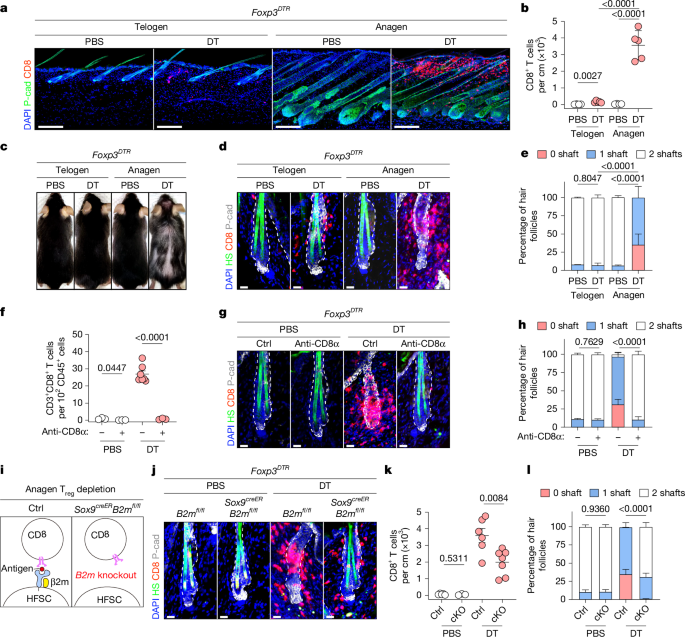
Autoimmune diseases arise from a breakdown of immune tolerance, yet the mechanisms that initiate tissue-specific autoimmunity remain poorly understood1,2,3,4. Here we identify a two-hit mechanism in which immune dysregulation and physiological neural activation converge to trigger autoimmune alopecia. We show that transient depletion of regulatory T (Treg) cells during the anagen phase of the hair cycle, but not during telogen, induces CD8+ T-cell-mediated destruction of immune-privileged hair follicle stem cells (HFSCs), resulting in hair loss. This anagen-restricted susceptibility depends on sympathetic nerve activity, which is physiologically elevated during anagen: sympathetic denervation prevents disease, whereas psychological stress or optogenetic activation of sympathetic nerves renders otherwise resistant telogen skin susceptible to autoimmune attack after Treg cell depletion. Mechanistically, sympathetic noradrenaline signalling through HFSC-intrinsic ADRB2 promotes physiological reactivation of endogenous retroviruses (ERVs) in anagen HFSCs. Under conditions of Treg cell depletion, this ERV-associated state drives autoimmune pathology by engaging AIM2-dependent innate immune activation and pathogenic CD8+ T cell responses. Accordingly, genetic ablation of Aim2 or pharmacological inhibition of ERV reverse transcription protects against disease development. Together, these findings show that physiological sympathetic activity establishes a transiently vulnerable epithelial state, whereas Treg cells prevent this state from progressing to tissue-specific autoimmunity. This neuro–epithelial–immune circuit links hair-cycle state to the breach of HFSC immune privilege and the initiation of autoimmune alopecia.
This is a preview of subscription content, access via your institution
Access Nature and 54 other Nature Portfolio journals
Get Nature+, our best-value online-access subscription
Prices may be subject to local taxes which are calculated during checkout
The scRNA-seq and bulk RNA-seq datasets generated in this study have been deposited in the NCBI Gene Expression Omnibus under accession codes GSE343853 and GSE343613, respectively. Source data are provided with this paper.
Rosenblum, M. D., Remedios, K. A. & Abbas, A. K. Mechanisms of human autoimmunity. J. Clin. Invest. 125, 2228–2233 https://doi.org/10.1172/jci78088 (2015).
Article
PubMed
PubMed Central
Google Scholar
Goodnow, C. C., Sprent, J., de St Groth, B. F. & Vinuesa, C. G. Cellular and genetic mechanisms of self tolerance and autoimmunity. Nature 435, 590–597 https://doi.org/10.1038/nature03724 (2005).