// ARS TECHNICA — MOBILE & WEB
Venus' mysterious haze is actually cosmic dust
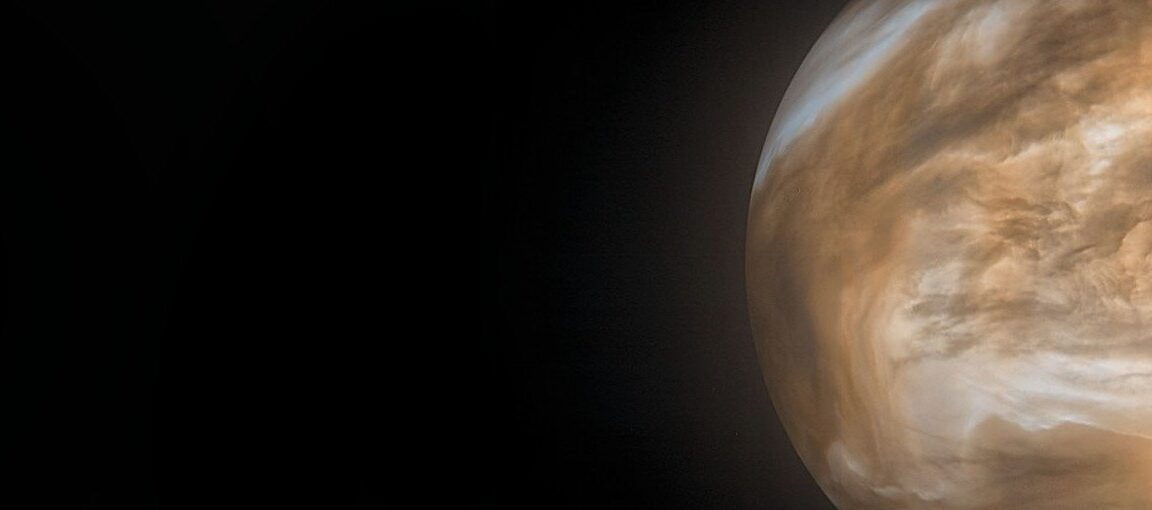
A physical model show that iron dust and sulfuric acid create the right properties.
Venus is shrouded in a veil of mystery. The yellowish “lower haze” at the bottom of its atmosphere was discovered by the Venera and Pioneer Venus probes in the 1970s. These spacecraft were some of the first to successfully send images of the planet back to Earth, but the haze they saw went unexplained for decades. Now the mystery Venus was keeping has been unveiled.
What nobody knew then was that the haze is an accumulation of particles from meteorites. “Shooting stars” that burn up in the atmosphere leave behind cosmic dust particles, and after sulfuric acid interacts with these particles, it leaves behind a haze. Planetary scientist Hiroki Karyu and his research team at Tohoku University in Sendai City, Japan, finally figured out how the haze formed using a microphysical model. This type of model involves microphysics—the micro-scale processes that create clouds and precipitation on Earth and other bodies.
“The continuous influx of cosmic dust is sufficient to sustain this lower haze layer with the particle size distribution observed by the entry probes,” Karyu said in a study published in Nature Astronomy. “These haze particles of cosmic origin act as efficient condensation nuclei, promoting cloud formation in the main cloud deck even far from their initial source.”
Previous speculation suggested the haze formed from volcanic ash. Venus is known as the most volcanically active planet in our Solar System, with signs of volcanism first observed by the Magellan spacecraft in the early 1990s. Recent studies discovered the planet is more volcanically active than previously thought, but the researchers found that ash belched out by Venusian volcanoes is not the source of haze particles.
Surface dust was also ruled out. Karyu found that even if there were much larger influxes of volcanic or surface dust on Venus, the particles would still not be able to interact with the atmosphere’s sulfur in the right way to form the haze.
Instead of simply accumulating dust, Venus’ haze forms through a process that starts similarly to how clouds form on Earth. Clouds come into being via condensation nuclei, tiny aerosol particles floating around in the atmosphere. These can range from dust and soot to volcanic ash and even sea salt. Liquid water can also condense around ice. Water molecules are usually too sparse to bond to themselves in the air, but they stick to the surfaces of these hygroscopic particles, forming the nucleus of a cloud droplet. These droplets then accumulate into clouds.
Karyu and his team used a microphysical simulation to show how cosmic dust forms the lower haze. When space rocks are pulled in by the planet’s gravity, they shoot through the atmosphere and encounter gas particles that cause friction. The faster and further a meteorite plummets, the more friction it encounters, which causes it to burn up and leave a trail of particles in its wake. Like water particles condense around the dust on Earth, droplets of sulfuric acid condense on the surface of the meteorite particles left hovering over Venus.
The researchers found that meteorite particles increase cloud production on Venus since they provide more opportunities for condensation. But surprisingly, more particles do not mean more cloud droplets. Instead, several particles stick together and form larger clusters before sulfuric acid condenses around them. Clouds of these condensates continue to grow heavier until they sink into the scorching lower atmosphere, where the sulfuric acid evaporates at temperatures that can reach 100° C (212° F).
Finding out what creates the lower haze on Venus unexpectedly solved another mystery. Something in Venus’ atmosphere had been absorbing ultraviolet rays, but until now, scientists had been unsure exactly what it was.