// NATURE NEWS — SPAZIO & SCIENZA
Stunning fossil shows dinosaurs' distinctive path to flight
Sarah Wild is a freelance journalist in Canterbury, UK.
Search author on:
PubMed
Google Scholar
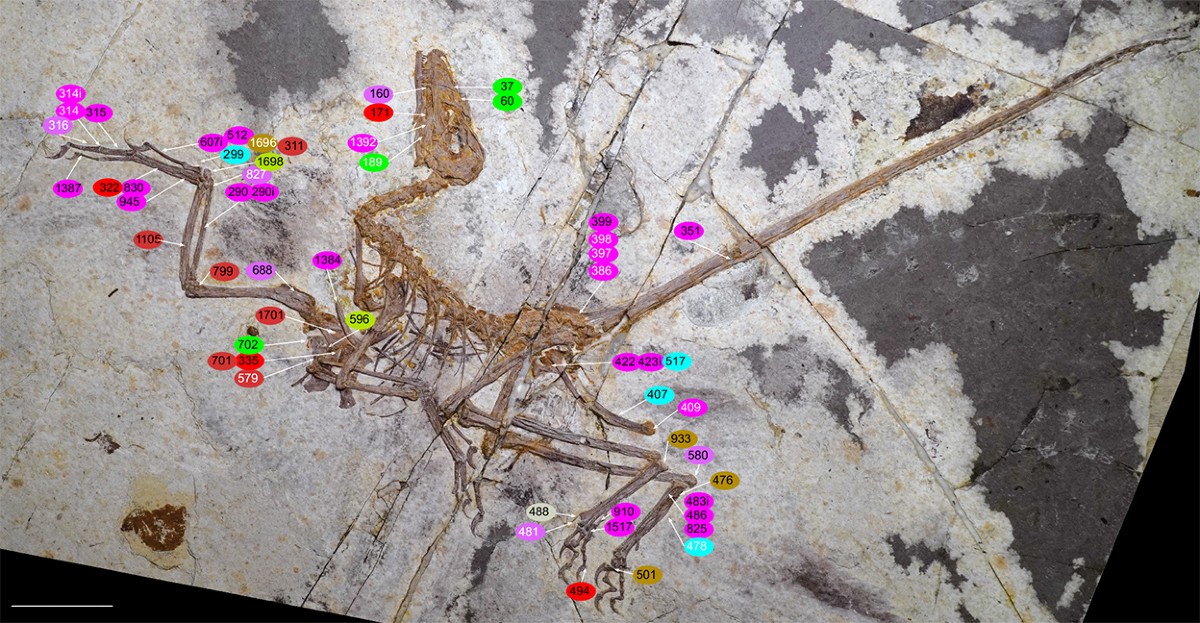
The Norellraptor barsboldi fossil shows traces of feathers on its fore and hind limbs as well as at the end of its tail. Credit: Xuri Wang et al./Nat. Commun.
The discovery of a species of feathered dinosaur in China, through a stunningly well-preserved fossil, adds to a growing body of evidence that birds and their closest relatives evolved the ability to fly several times rather than through a single lineage.
The specimen, which is 57 centimetres long, is a microraptorine that roamed what is now Liaoning province in China between 145 and 100 million years ago. It was discovered by a local farmer and described by an international team of researchers from China, Italy and Slovakia in Nature Communications on 29 September1. The team named the species Norellraptor barsboldi and estimate that the specimen would have been about three years old when it died.
Microraptorines are a group of relatively small meat-eating dinosaurs, weighing around one kilogram, that had feathers on their limbs. Hundreds of specimens have been found. The feathered creatures are part of a complete branch, or clade, of the tree of life called Microraptorinae. They are close relatives to birds, which are part of the Avialae clade, and so they offer insight into the origins and evolution of flight.
By comparing the flight-related adaptations of known microraptorines with those observed in the bird lineage, the researchers found that 30% of the 194 flight-related adaptations identified in microraptorines also evolved in the Avialae. These include wing feathers, hook-shaped toe bones and a longer bone in the forearm than in the upper arm.
But these adaptations did not develop in the same order in the two groups and “thus could not be considered the expression of a shared developmental regime”, the researchers write.
Palaeontologists welcome the research. “The study provides important new evidence that further supports the hypothesis that flight evolved multiple times among feathered dinosaurs, including at least once among microraptorines and at least once among birds,” says Michael Pittman, a palaeobiologist at the Chinese University of Hong Kong.
Fossilised hind limbs of Norellraptor barsboldi. Credit: Xuri Wang et al./Nat. Commun.