// NATURE NEWS — SPAZIO & SCIENZA
Brain organoids grafted into cortex-free mice will advance human brain research
Marty G. Yang is in the Department of Biological Chemistry, University of California, Los Angeles, Los Angeles, California 90095-1737, USA.
Search author on:
PubMed
Google Scholar
Aparna Bhaduri is in the Department of Biological Chemistry, University of California, Los Angeles, Los Angeles, California 90095-1737, USA.
Search author on:
PubMed
Google Scholar
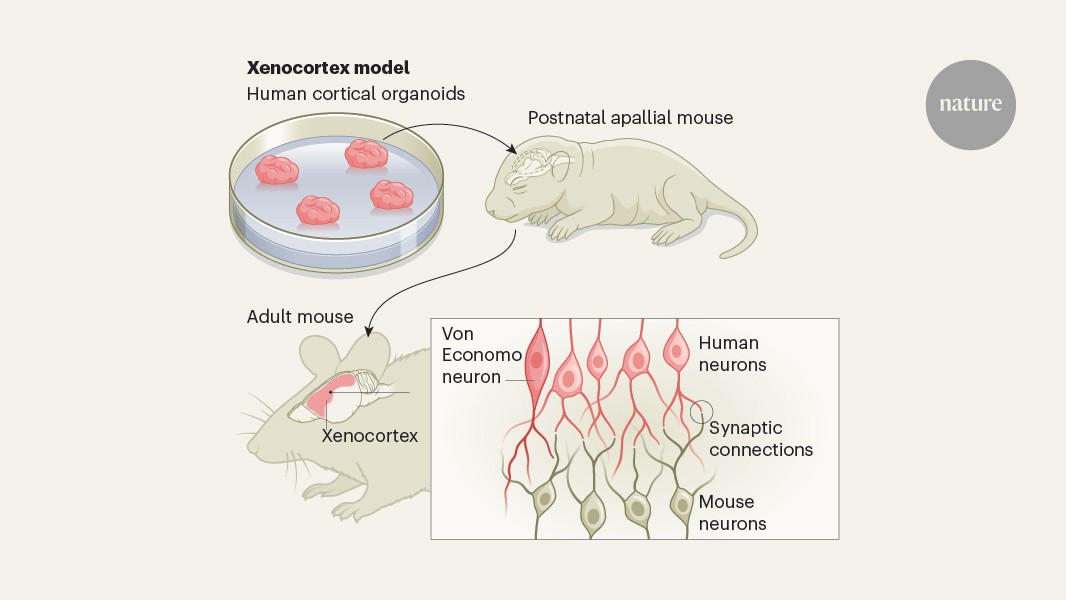
Models of the brain — known as brain organoids — that are built from stem cells have transformed the study of human-specific developmental processes and disease-specific traits. But existing tools are restricted by several factors: organoids cannot mature beyond a certain point; they mostly lack interactions with other brain structures; and it is impossible to get any kind of behavioural output from them. Writing in Nature, Kaganovsky et al.1 address these limitations using an innovative experimental model: an engraftment of human brain organoids into a living mouse.
Access Nature and 54 other Nature Portfolio journals
Get Nature+, our best-value online-access subscription
Prices may be subject to local taxes which are calculated during checkout
Article
PubMed
Google Scholar
Article
PubMed
Google Scholar