// NATURE NEWS — SPAZIO & SCIENZA
Daily briefing: Medicine Nobel prize goes to optogenetics
Search author on:
PubMed
Google Scholar
Hello Nature readers, would you like to get this Briefing in your inbox free every day? Sign up here.
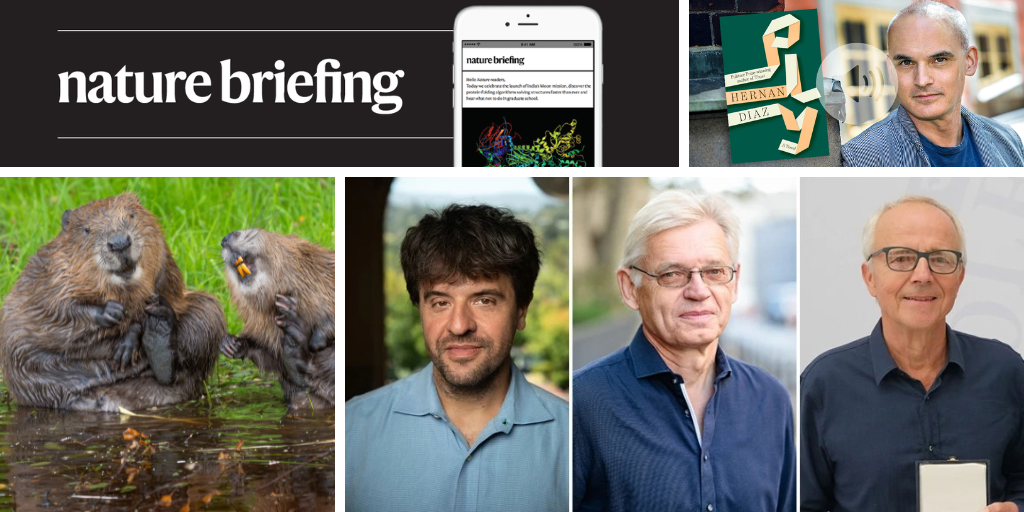
Left to right: Karl Deisseroth, Peter Hegemann and Georg Nagel were awarded the 2026 medicine Nobel on 5 October.Credit: L-R Stanford Medicine, Humbold-Universität zu Berlin/Philipp Plum, Robert Emmerich/Universität Würzburg
The 2026 Nobel Prize in Physiology or Medicine has been awarded to Karl Deisseroth, Peter Hegemann and Georg Nagel for their work in optogenetics — a technology that allows researchers to control the brain’s neurons with pulses of light. In the early 2000s, Hegemann and Nagel discovered a light-sensitive protein — channelrhodopsin — in an alga that swims towards light. In response to blue light, the protein opens to allow charged molecules to flood into cells, creating a tiny electrical charge. In later work, Deisseroth and his colleagues inserted the gene encoding channelrhodopsin into neurons, and found that it could cause the cells to fire and communicate with other neurons.
Learn about optogenetics from laureate Karl Deisseroth himself in this video lecture from 2013. (iBiology | 38 min watch)
After 15 years of covering the Nobel prizes for Nature, I no longer bother trying to predict who will win — in part because optogenetics has been a front runner for so many years. “We’ve been waiting for this for a long time,” neuroscientist Michael Häusser told me earlier today. “What took them so long?” The wait might have been because the direct application of optogenetics to human disease and biology has emerged only in the last few years. For example, the technique has been harnessed as an experimental therapy to partially restore vision in people with retinitis pigmentosa. “It’s become clear that optogenetics has enormous therapeutic potential,” Häusser says.
“I immediately knew that optogenetics was going to have an unprecedented impact on neuroscience because it was a technology that virtually all neuroscientists had been waiting for, one way or another, consciously or not.”
In 2015, neurosurgeon Ivan Soltesz and a host of other optogenetics leaders reflected on progress since a seminal 2005 paper by Deisseroth and Nagel, alongside Edward Boyden, Feng Zhang and Ernst Bamberg. (Nature Neuroscience | 50 min read)
A single clinical trial of children in Iran might have wrongly swayed medical evidence in favour of using Prozac (fluoxetine) to treat depression in children and adolescents. A group of researchers are now calling that trial’s findings into question, and suggest that the evidence for Prozac’s recommendation in paediatric clinical guidelines should be reevaluated. It’s rare to find such a clear example of a single flawed study affecting the result of systematic reviews in medicine, says psychiatrist and study co-author Florian Naudet. The trial in question reported “the kind of effect size you only get if you ask people whether they prefer chocolate or faeces”, says clinical psychotherapist Martin Plöderl.
Reference: Cochrane Evidence Synthesis and Methods paper