// NATURE NEWS — SPAZIO & SCIENZA
Chemistry Nobel for solving mystery of how ‘handed’ organic molecules can emerge
Search author on:
PubMed
Google Scholar
Search author on:
PubMed
Google Scholar
Search author on:
PubMed
Google Scholar
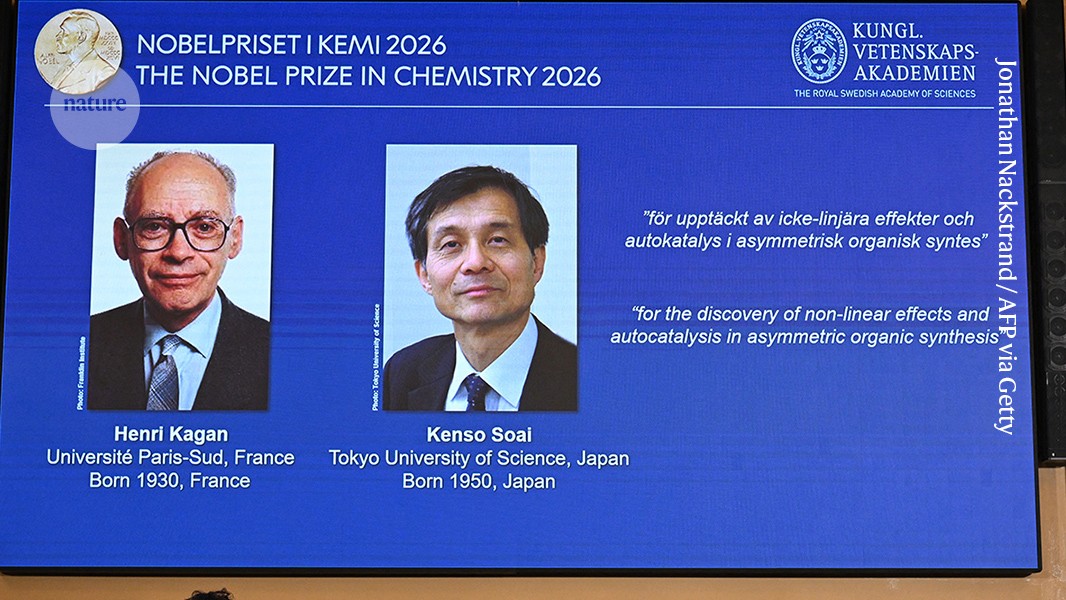
The winners of the 2026 Nobel Prize in Chemistry, Henri Kagan and Kenso Soai, were announced on 7 October.Credit: Jonathan Nackstrand/AFP via Getty
Two scientists who solved the chemical mystery of why some reactions create molecules that are just one of two possible mirror-image variants have won this year’s Nobel Prize in Chemistry.
Henri Kagan, University of Paris-Sud in Orsay, France, and Kenso Soai, Tokyo University, Japan, share the 12-million Swedish kronor (US$1.2-million) prize, announced by the Royal Swedish Academy of Sciences in Stockholm on 7 October.
Medicine Nobel awarded for brain ‘switch’ that controls neurons with light
“I am very excited to receive the very nice news about the Nobel prize. This is one of the most exciting days in my life,” said Soai, speaking to the Nobel committee after the prize was announced. Soai said he was out shopping nearby his house when he received the call.
While they could occur in either form, life’s building blocks are one-handed or ‘homochiral’ — for example, DNA is right-handed while amino acids are left-handed. The prize-winning discovery relates to the key question of how this chemical asymmetry emerges in nature.
In experiments in the 1980s, French chemist Kagan showed how a small asymmetry in handedness in a catalyst can be amplified in the reaction products. In 1995, Soai found a reaction in which a chiral product was also itself a catalyst, driving even greater asymmetry in handedness. Together they suggest how natural reactions in living organisms might overwhelmingly produce just one type of mirror-image molecule.