// NATURE NEWS — SPAZIO & SCIENZA
A nuclear clock synchronized to 229Th
Nature
(2026) Cite this article
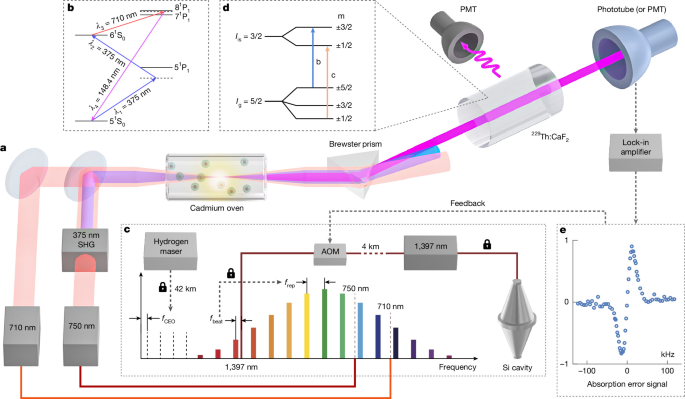
Atomic clocks have made time and frequency the most precisely measured quantities in physics, progressing from microwave standards that realize the SI second1 to optical clocks with unprecedented precision2. A nuclear clock transfers the frequency reference from an electronic to a nuclear transition and the uniquely low-lying, laser-accessible, isomeric transition in 229Th currently offers the most practical route to compact, robust timekeeping and sensitive tests of fundamental physics3,4,5,6,7,8. Realizing such a clock requires turning spectroscopy of the 229Th nuclear resonance9,10,11,12,13,14,15,16,17 into a stable discriminator for steering a traceable oscillator. Here we demonstrate a 229Th nuclear clock by stabilizing a continuous-wave, narrow-linewidth 148.4 nm vacuum-ultraviolet (VUV) laser18 to a resolved, weakly temperature-sensitive nuclear transition17,19 in 229Th:CaF2 crystals20,21,22. A 10-μW VUV source generated by four-wave mixing in cadmium vapour18,23,24 and phototube-based frequency modulation absorption readout provide a fast, high-signal-to-noise nuclear discriminator. The clock reaches a fractional frequency instability of \(5\times 1{0}^{-13}/\sqrt{\tau /{\rm{s}}}\) for averaging time τ. Clock-transition frequencies measured in two independently fabricated crystals agree at the 10−13 level and are consistent with previous VUV-comb measurements on other 229Th:CaF2 crystals17. These results establish laser-addressed nuclei as operational clock references and provide a reproducible solid-state platform for compact nuclear clocks, nuclear quantum sensors and precision tests of fundamental physics.
Laser generation and laser spectroscopy are rooted in the electronic structure of atoms, molecules and solids. Nuclear transitions, by contrast, usually occur at energies far above typical electronic transitions, leaving most nuclear resonances beyond direct coherent access with conventional optical spectroscopy. The 229Th isomer is a singular exception. Its transition energy lies in the vacuum-ultraviolet (VUV) range, making it the only known nuclear transition that can be addressed directly with current laser technology. This coincidence opens a route to quantum coherent control of a nucleus and, in particular, to a nuclear clock, in which the frequency reference is shifted from the electronic shell to the atomic nucleus.
Decades of work established the existence and energy of this low-lying state9,10,11,12,25,26,27,28,29,30,31. The observation of radiative decay from 229Th-doped crystals further showed that the isomer can remain long-lived in VUV-transparent hosts13,32,33,34,35. Building on these developments, direct laser excitation of the 229Th isomer has been achieved recently14,15,16,36, and VUV-frequency-comb spectroscopy has enabled precision measurement of the nuclear transition frequency against optical atomic clocks16. In crystalline hosts, spectroscopy has further resolved the solid-state structure of the nuclear resonance, including quadrupole-split transitions16, site-dependent shifts36,37, temperature sensitivities19 and reproducible transition frequencies across crystals17. Together with the macroscopic number of nuclei provided by a solid-state host38,39,40, these advances open the possibility of compact and field-deployable nuclear frequency references.
Another enabling element for clock operation is a continuous-wave VUV source at the nuclear resonance. Resonantly enhanced four-wave mixing in metal vapour18,23,24 and randomly quasi-phase-matched SrB4O7 (refs. 41,42) have provided routes to continuous-wave 148.4-nm radiation. Converting nuclear laser spectroscopy into clock operation requires combining, in a single system, a traceable narrow-linewidth VUV probe, a 229Th-containing reference and a high-bandwidth, high-signal-to-noise readout of weak nuclear response, together with a demonstration of nuclear-transition-frequency repr