// NATURE NEWS — SPAZIO & SCIENZA
A chiral superlattice route to spin-split topological antiferromagnetism
Nature
volume 658, pages 342–349 (2026) Cite this article
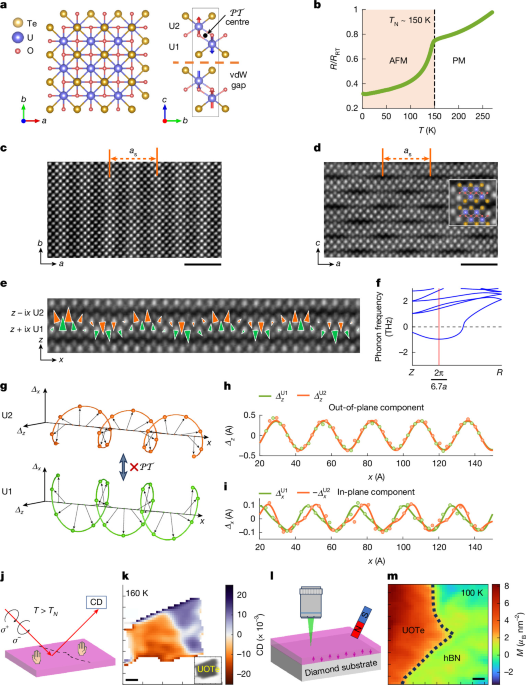
Chirality has emerged as a new mechanism for inducing spin and Berry-curvature phenomena in quantum materials and molecular chemistry1,2,3,4,5,6,7. Collinear antiferromagnets (AFMs) are promising for spintronics and topological magnetism, yet realizing large Berry curvature and spin-split bands remains challenging8,9. Here we report a chiral-superlattice route to spin-split topological phenomena from collinear antiferromagnetism. We study the collinear AFM UOTe, in which we show a spontaneous chiral superlattice arising from frozen chiral phonons at a finite wave vector. Without the superlattice, the pristine collinear AFM in UOTe has neither Berry curvature nor spin-split bands. When electrons move through the chiral superlattice, their orbital Bloch wavefunction and quantum geometry are modulated by the strong chiral superlattice potential, generating large Berry curvature, which we detect by the nonlinear Hall effect. At 150 K, the chiral-superlattice-induced Berry curvature couples to the collinear AFM order, leading to an anomalous Hall angle of about 0.14 abruptly near the Néel temperature TN which is among the largest in bulk magnets. Moreover, our spin Hanle precession measurement shows that the chiral superlattice also generates spin-polarized current from the collinear AFM, a long-standing goal in spintronics. We shed light on the supermodulation formation mechanism based on chemical ion size and physical interlayer–intralayer energy competitions, which we use to propose a design principle to discover similar bond-mismatch superlattices, providing a chiral superlattice pathway through real-space engineering of quantum geometry10,11.
This is a preview of subscription content, access via your institution
Access Nature and 54 other Nature Portfolio journals
Get Nature+, our best-value online-access subscription
Prices may be subject to local taxes which are calculated during checkout
Bloom, B. P., Paltiel, Y., Naaman, R. & Waldeck, D. H. Chiral induced spin selectivity. Chem. Rev. 124, 1950–1991 (2024).
Article
CAS
PubMed
PubMed Central
Google Scholar
Chang, G. et al. Topological quantum properties of chiral crystals. Nat. Mater. 17, 978–985 (2018).
Article
CAS
PubMed
Google Scholar