// SPACE.COM — SPAZIO & SCIENZA
Astronomers watch 'vampire' star feeding on the stellar equivalent of 5 trillion quarter-pounder burgers every second
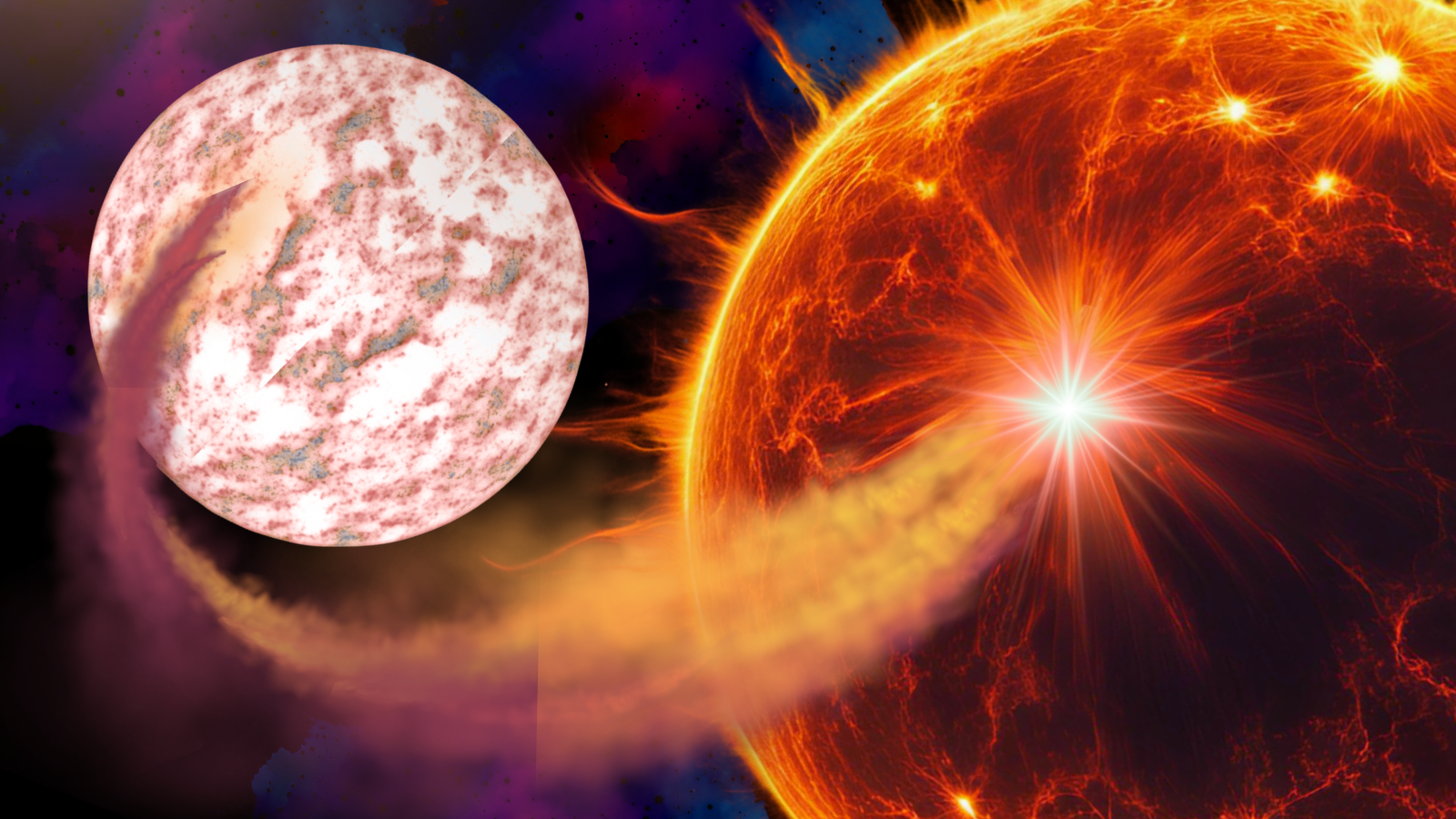
The cannibal star could keep on snacking on its brown dwarf victim for billions of years.
When you purchase through links on our site, we may earn an affiliate commission. Here’s how it works.
Astronomers have observed a "vampire" star feeding on a brown dwarf companion for the first time. It is a slow and gruesome death that could last for billions of years, despite the fact that the star is snacking on the equivalent of 5.2 trillion quarter-pounder burgers every second.
Brown dwarfs straddle the line between planets and stars, with masses from 13 to 80 times that of Jupiter or 0.013 to 0.08 times that of the sun. They get their unfortunate nickname "failed stars" because, though they form from a collapsing cloud of dense gas, they fail to gather enough mass to trigger the nuclear fusion of hydrogen to helium in their cores, the process that defines what a star is.
This newly discovered brown dwarf, found to be a snack for a small companion star, is located in the system ZTF J0440+2325, which dwells around 300 light-years from Earth. This represents the first time astronomers have seen a low-mass star acting as a stellar vampire, stealing material from a low-mass stellar companion. The slow rate at which this is occurring indicates this cosmic vampirism will last for hundreds of thousands to billions of years.
"When we think of stars interacting with planets or brown dwarfs, the picture is always that the star eventually swallows the other thing," team member Kevin Burdge of the Massachusetts Institute of Technology (MIT) said in a statement. "This is what will happen to the Earth when the sun becomes a red giant. But here, we've found an alternative: Instead of swallowing the thing up, the star can gradually eat it for billions of years."
This new system was first observed in observations of the sky conducted by the Zwicky Transient Facility (ZTF) in the form of a strange light triangle that repeatedly appeared in the data.
"I remember first looking at this and thinking: Stars don't make triangular waveforms like this," Burdge explained.
At the time, Burdge and colleagues were hunting for so-called "black widow pulsars" that contain a stellar remnant called a neutron star feasting on a companion star much like how the arachnid of the same name devours its prey. However, because these systems contain a low-mass object gravitationally tugging on a high-mass companion, there is usually a "wobble" in their light signature, and the team found no "wobble" in this particular light signature.
"We weren't seeing that whipping back and forth here," said Burdge. "It didn't make any sense. We couldn't explain what this was."