// ARS TECHNICA — HARDWARE & GADGET
The biggest race in the world? The 24 Hours of Le Mans is this weekend.
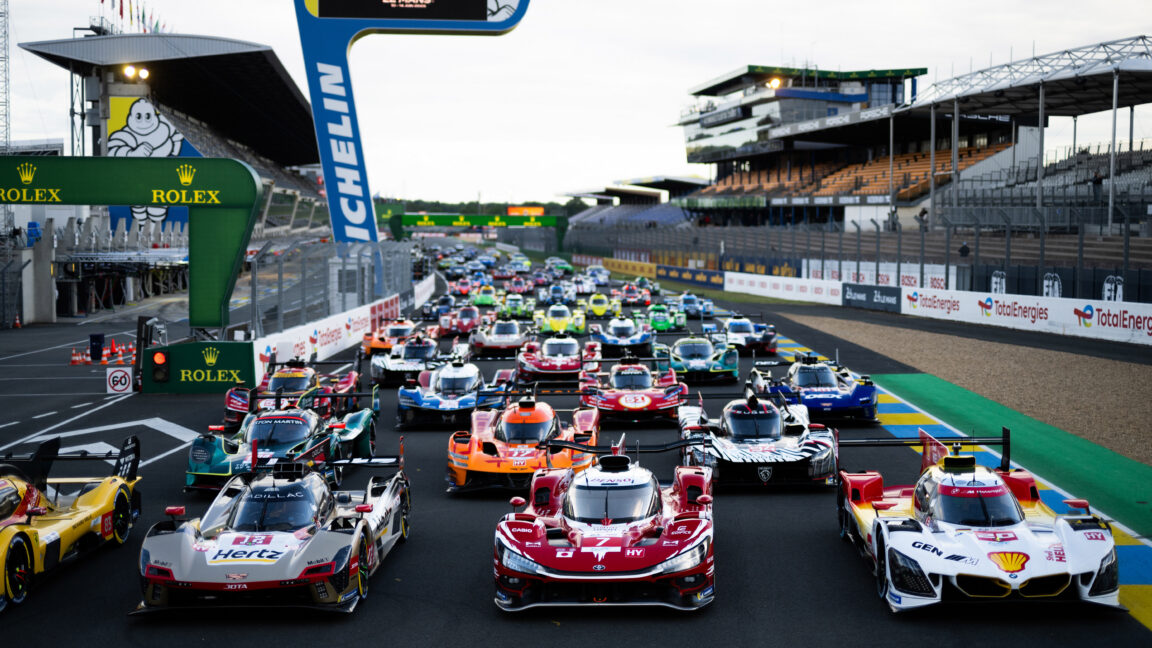
More than 350,000 spectators will watch 62 cars compete, day and night.
One of motorsport’s three biggest races takes place this weekend in France. It is the annual 24 Hours of Le Mans, an endurance race that, together with the Indianapolis 500 and the Monaco Grand Prix, make up the ‘triple crown,’ an unofficial achievement that only the late Graham Hill can claim to have won. This year, 62 different cars take the start, racing on a mix of permanent race track but also public roads that for the rest of the year are how locals get to the supermarket or the local McDos.
It’s not the oldest race in the world, but it’s up there—it was first held in 1923, and this year will be the 94th running. It was started as a way to give the automotive industry a grueling test for their new machinery and has remained the area of motorsport with the most road relevance. Disc brakes crossed over from aerospace to road cars at Le Mans, and better brakes continue to be tested there today, but it’s also where companies like Porsche and Audi and Toyota proved new hybrid technology, brake-by-wire systems, direct-injection engines, and advanced headlights, to name but a few.
This year, the 62 cars are split across three different classes, each crewed by three drivers who take shifts at the wheel. Some of the drivers are pros—among the world’s very best. But plenty are amateurs; in the past, lots of dentists, oddly enough. But with the cost of racing these days, it’s the tech bros. The Ruby on Rails creator, the co-founder of GitHub, and the co-founder of Crowdstrike are all racing in the LMP2 class. And Valve’s Gabe Newell owns the Aston Martin team that is competing in both Hypercar—with the outrageous-looking and -sounding Valkyrie—as well as in LMGT3, where his son Gray will be one of the drivers.
The top class, with the fastest cars, is called Hypercar, contested by factory teams and all-professional driver lineups. We’ve written about Hypercar quite a lot over the past few years, together with the closely related GTP class that races in IMSA’s WeatherTech series over here. These are closed-roof mid-engined prototypes, most of them hybrids purpose-designed to go racing.
Ferrari, Peugeot, and Toyota each designed their cars completely in-house to a set of regulations called LMH, which allows them to put the electric hybrid motor at the front axle, although the cars can only use this temporary all-wheel drive above 93 mph (150 km/h).
Aston Martin also builds its car to LMH, but the Valkyrie started life as a road car, designed by F1 legend Adrian Newey. But it had to lose the road car’s hybrid system and quite a lot of power and aerodynamic downforce in order to comply with the LMH ruleset. Ironically, the Valkyrie is perhaps the truest car competing in the Hypercar class—when the category was first proposed by the Automobile Club de l’Ouest (which organizes the race), the idea was to get racing versions of road-going hypercars like the Valkyrie or Mercedes’ AMG-One. At least until everyone realized how expensive and difficult that might be; only Aston Martin remained up for that challenge.
The bulk of Hypercar—Alpine, BMW, Cadillac, and now Genesis—are cars built to LMDh specifications, imported from IMSA in Daytona Beach, Florida. But those OEMs aren’t responsible for all of the car. The central carbon-fiber chassis or spine comes from one of four different builders (Oreca, Dallara, Multimatic, Ligier), and all LMDh cars must use the same transmission, hybrid motor, and hybrid battery. The automakers then design the bodywork and bring their own engines and software to the party. LMDh is a cheaper approach than LMH, but it’s also notable that during the first three years of the class, which was introduced in 2023, an LMDh car has yet to actually win Le Mans, a fact that almost certainly explains the absence of Porsche from the top category in 2026.
If all that sounds a bit complicated, that’s sportscar racing for you. To keep performance le