// SPACE.COM — SPAZIO & SCIENZA
Four years ago, NASA punched an asteroid. Europe's Hera probe arrives this month to inspect the wreckage
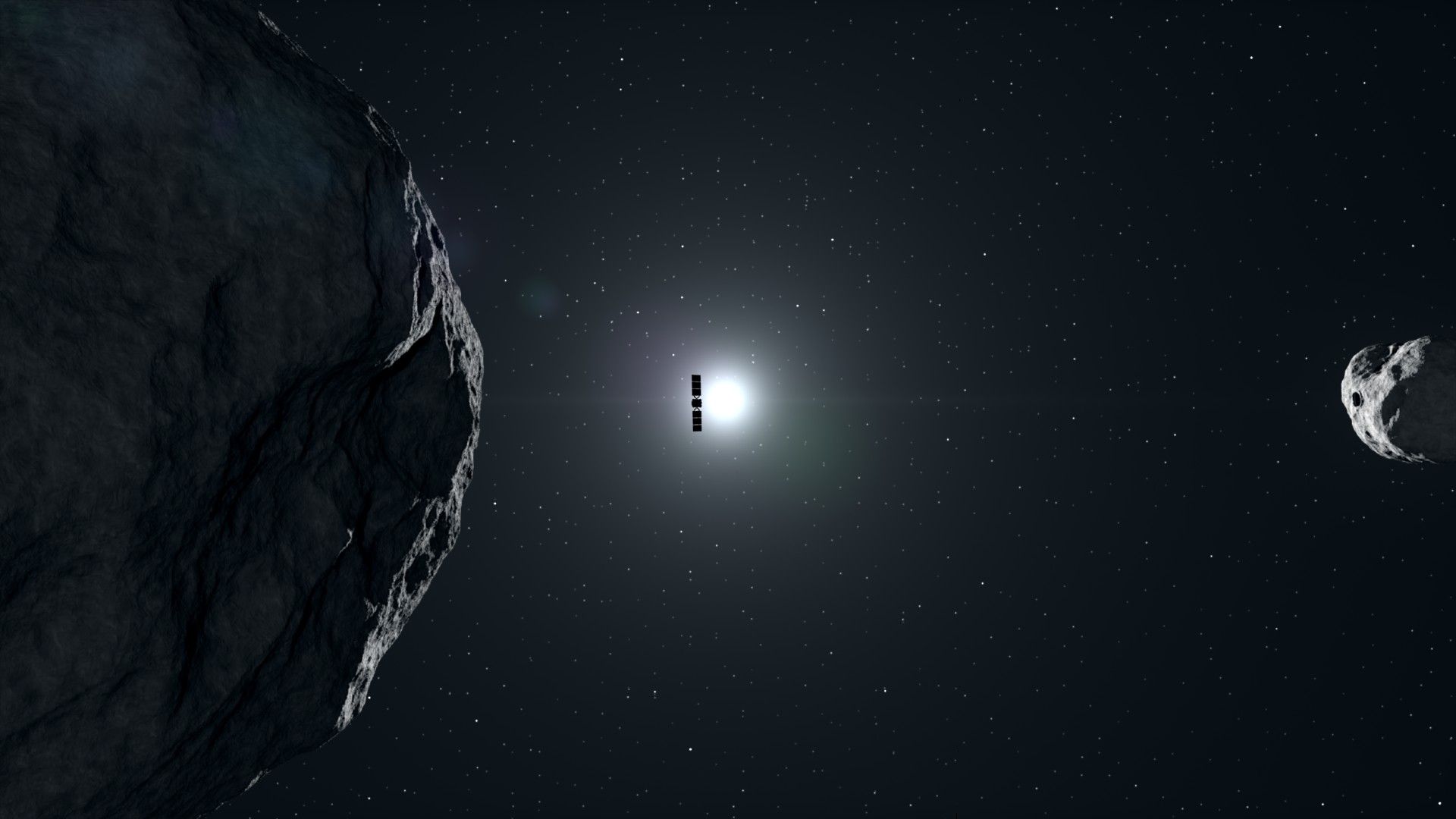
Scientists can't wait to explore the crash site of NASA's first planetary defense mission.
When you purchase through links on our site, we may earn an affiliate commission. Here’s how it works.
NASA's DART mission made a cosmic mess four years ago — and now a new spacecraft is ready to scout out exactly what the first-of-its-kind collision accomplished.
The Double Asteroid Redirection Test (DART) spacecraft slammed into a small space rock called Dimorphos on Sept. 26, 2022, in humanity's first test of planetary defense. That's the field dedicated to protecting Earth from the possibility of a calamitous asteroid impact, and DART mimicked how humans could change the orbit of a threatening space rock, taking it off its collision course.
The mission definitely succeeded, shortening the little asteroid's orbit around a larger rock called Didymos by about 33 minutes. But in order to make the most of the experiment, scientists ensured a second spacecraft would follow DART at a more leisurely pace. That decision will pay off this month with the arrival of a European Space Agency (ESA) spacecraft dubbed Hera, which launched in October 2024, two years after DART's impact.
"Hera wants to be the detective, like Inspector Colombo, going back to the crash scene," said Patrick Michel, a planetary scientist at the French National Centre for Scientific Research (CNRS) and principal investigator of the Hera mission.
Scientists have been able to do limited monitoring of the Didymos system over the years with telescopes both on the ground and in space. That's how they calculated the basic change to the orbit, and they've built a basic sketch of what happened.
"We know that there was a lot of material kicked up," said Angela Stickle, a planetary scientist at Johns Hopkins University's Applied Physics Laboratory affiliated with both missions. "We know that we probably left a pretty significant mark on Dimorphos."
But the story isn't over and scientists are far from satisfied. No one knows how big a crater the impact left, or whether it completely rearranged all the asteroid's boulders. There are hints Dimorphos is now tumbling, and material may have moved between it and the larger Didymos.
Even the change to the orbit is complicated, said Cristina Thomas, a planetary astronomer at Northern Arizona University affiliated with both missions: The time Dimorphos took to circle Didymos was still changing some six months after impact, for reasons that aren't clear. "This thing that we thought was going to be very cut and dry turned out to be really interesting and complicated," Thomas said.