// NATURE NEWS — SPAZIO & SCIENZA
Smartwatch health data are piling up. How can doctors keep pace?
Bianca Nogrady is a freelance science journalist based in the Blue Mountains, west of Sydney, Australia.
Search author on:
PubMed
Google Scholar
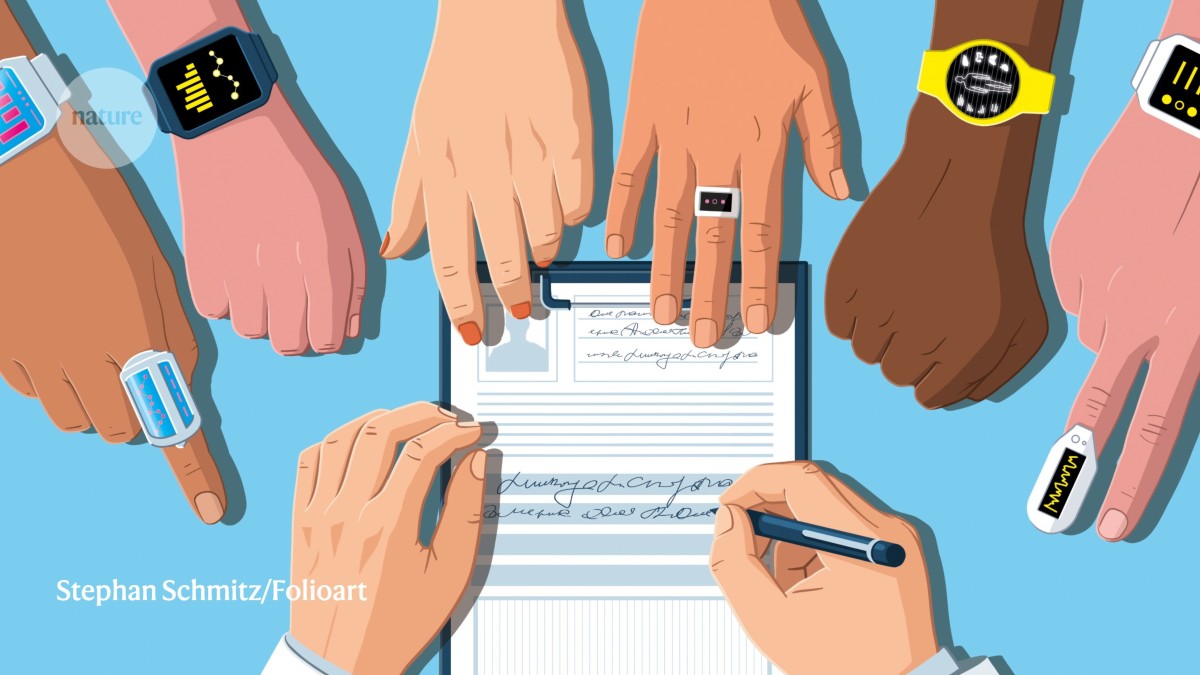
Non-medical devices are generating vast volumes of data that clinicians must find a way to process and weigh up. Illustration: Stephan Schmitz/Folioart
Wearable devices that can track health data offer a promising new research frontier, but a journal case study published in 2020 illustrates one of their core problems1.
The study describes a 70-year-old woman with paroxysmal atrial fibrillation — bouts of fast, irregular heartbeat that can be symptomatic or silent. This form of atrial fibrillation often resolves without treatment, but because of the patient’s other risk factors for stroke, her doctors put her on anticoagulant medication to lower the chance of a deadly blood clot.
The patient wore a smartwatch that included an app for monitoring heartbeat and generating electrocardiogram (ECG) readouts. In the year following her diagnosis, she checked those ECG readouts 916 times. She turned up to one consultation with her electrophysiologist — clinicians who specialize in arrhythmia — with a printed stack of those ECGs, according to Lindsey Rosman, who co-authored the paper describing the case.
“When I say stack, I mean hundreds,” says Rosman, a clinical health psychologist at Northwestern University in Chicago, Illinois.
This example illustrates the huge challenge that wearable devices — often not approved for medical use and now being worn by hundreds of millions of people globally — are posing in terms of the vast amount of data they produce. Patients, clinicians and researchers are increasingly having to make sense of this growing mountain of information, whether from approved or non-approved devices, without getting overwhelmed. But if this can be overcome, there are potentially groundbreaking applications for consumer devices, or clinically developed ‘medical-grade’ wearables, in diagnosing, managing or preventing heart conditions, neurological disorders and metabolic diseases.
From the perspective of doctors who specialize in heart-rhythm disorders, devices such as smartwatches present an extraordinary technological opportunity. “For the first time, we could monitor our patients for long periods with inexpensive devices,” says Rod Passman, a cardiac electrophysiologist and director of the Center for Arrhythmia Research at Northwestern Medicine in Chicago, Illinois.
That’s especially useful in atrial fibrillation, in which a chronic or worsening irregular heartbeat raises the risk that blood will pool in the left atrium and form a clot that can travel to the brain and cause a stroke. Around one in three people with atrial fibrillation will experience a stroke, so are put on blood-thinning medication for life. But anticoagulants come with side effects, including the risk of excessive bleeding.