// NATURE NEWS — SPAZIO & SCIENZA
Daily briefing: What makes a happy scientist at work?
Search author on:
PubMed
Google Scholar
Hello Nature readers, would you like to get this Briefing in your inbox free every day? Sign up here.
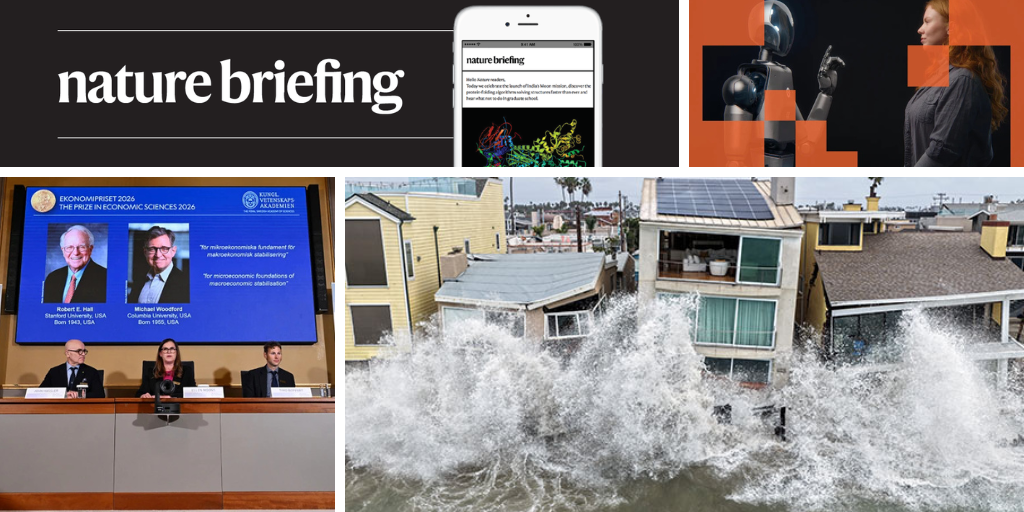
For the second time ever, US national forecasters issued a tropical storm watch for Southern California as Tropical Storm Rachel, an emerging El Niño and a Kelvin wave compounded conditions in the region. (Mario Tama/Getty)
A huge surge of water known as a Kelvin wave is showing what sea-level rise, driven by climate change, could do to the West Coast of North America. This type of underwater wave, named after polymath Lord Kelvin (of absolute-temperature-scale fame), originated at the Equator as a normal part of the El Niño weather event — and it’s not the first, and won’t be the last, this year. But, combined with high tides and record-breaking warm water, this wave could cause sea levels up to 60 centimetres (2 feet) higher than normal in California, says climate scientist Daniel Swain. “What we’ll see at the worst this winter will be something that is closer to the norm later this century in terms of sea level,” says Swain.
A new tool called IdeaLens can help to judge whether concepts — rather than just writing — in documents have been generated by artificial intelligence, the team behind it says. The detector works by distilling a text into an outline, stripping it of style. Then it looks for patterns that are characteristic of either AI or human-generated ideas, such as in arguments and flow. In tests, the detector was able to spot AI-derived ideas 91% of the time, but researchers warn that the tool is fallible and shouldn’t be used to judge individual cases.
The 2026 Sveriges Riksbank Prize in Economic Sciences in Memory of Alfred Nobel has been awarded to economists Robert E. Hall and Michael Woodford for their research on how to stabilize an economy to avoid socially and economically damaging fluctuations in inflation, growth and employment. Hall and Woodford’s work builds on the macroeconomic picture drawn by influential economist John Maynard Keynes. Their work dives deep into the microeconomic perspective, which considers how decisions made by individual businesses and households affect prices, earnings and spending.
The Wellcome Photography Prize is in its final weeks of accepting entries for its 30th anniversary edition next year. “We're looking for compelling images that explore urgent health challenges and scientific discovery — from mental health, infectious disease and climate change to the fundamental research that expands our understanding of life, health and wellbeing,” says Wellcome. It’s open to everyone. Submit your work by 21 October 2026 for the chance to win up to £10,000.
Most researchers are satisfied with their work, and meaningful work, flexibility and job security all matter more than salaries do, according to Nature’s 2026 science-job satisfaction survey, which had around 3,900 self-selecting respondents across 133 countries. That being said, those who have well-paid, senior and permanent positions are more satisfied than are other researchers. The country with the happiest scientists, of those with more than 100 respondents, was Canada. The least satisfied cohort was in China, although they are the most likely to say that their career prospects are better than those of previous generations.
The number of medical doctors who also do research is dwindling, risking the future of valuable health care studies and translational medicine, argues a group of physician–scientists. A coordinated effort across governments, funders, health systems and universities is required to maintain the pipeline of talent into this profession. The endeavour should include protections for research time, reassessment of pay structures and changes to targets so that physician–scientists aren’t expected to meet the same benchmarks as clinical-only staff, the group writes.
Plenty of people are getti