// NATURE NEWS — SPAZIO & SCIENZA
World's timekeepers upend how they adjust time to avoid catastrophic 'negative second'
Search author on:
PubMed
Google Scholar
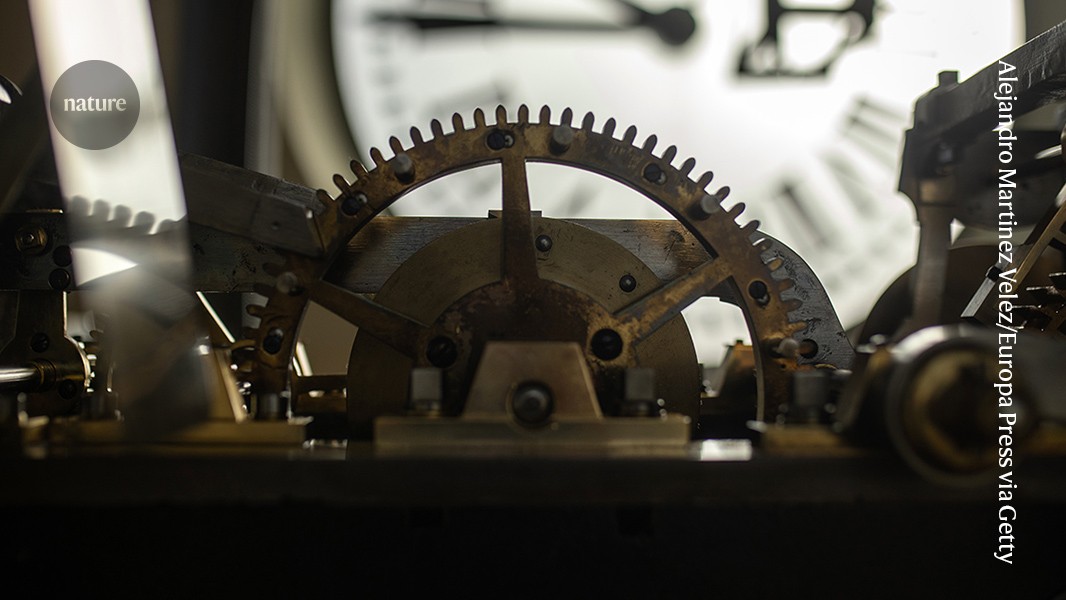
Metrologists retire the leap second immediately, instead of by 2035. Credit: Alejandro Martinez Velez/Europa Press via Getty
Time discrepancies that used to be adjusted by a jump of a second around once every 1.5 years will now wait until an hour needs correcting instead.
Leap seconds serve to align time given by the sun’s position in the sky, which is based on Earth’s unsteady natural rotation, with the more stable ticking of atomic clocks, known as Universal Coordinated Time (UTC). But the rogue seconds have been a thorn in timekeepers' sides, disrupting computing systems and causing misalignment between clocks on the day they are implemented.
Their replacement — a shift of an hour once Earth time and atomic time drift apart by 3,600 seconds — likely won’t be needed for thousands of years, effectively pushing the issue onto future generations.
Member states of the General Conference on Weights and Measures (CGPM) voted to pass the resolution at their 28th meeting, outside Paris, on 15 October.
“This decision will ensure the continuity and relevance of UTC for centuries to come,” says Georgette Macdonald, director general of the National Research Council of Canada’s Metrology Research Centre in Halifax, Canada. Canada backed the resolution, which was not supported unanimously but only needed a majority to pass, she says.
“This is a historical moment, a decisive step for UTC”, says Noël Dimarcq, a metrologist at the Côte d'Azur Observatory in Nice, France, who formally introduced the resolution. "We now have an international reference time scale [that is] continuous for the next millennia", he adds.
Earth’s mysterious inner core really is changing shape
Over 20,000 precolonial earthworks in the Southwest Amazonia