// NATURE NEWS — SPAZIO & SCIENZA
Margaret Hamilton obituary: computer scientist who pioneered software engineering and helped us get to the Moon
Maia Weinstock is deputy editorial director at MIT News, an MIT lecturer on the history of women in STEM at the Massachusetts Institute of Technology in Cambridge, and an author.
Search author on:
PubMed
Google Scholar
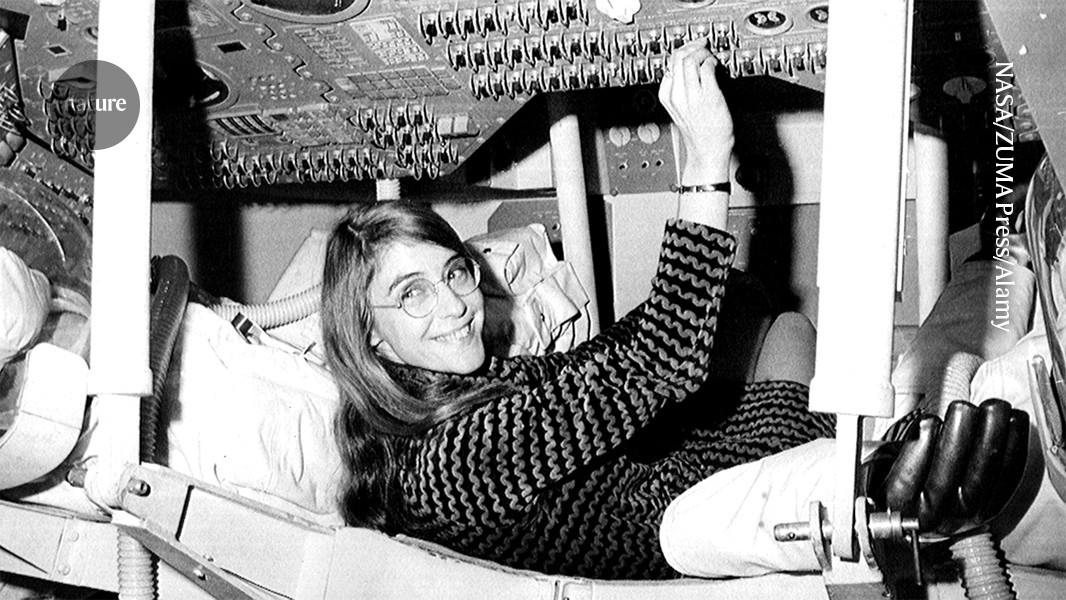
Margaret Hamilton — a titan of computer science — has died aged 90. She is best known for her work in developing the software for NASA’s Apollo project, which landed the first humans on the Moon.
Hamilton’s influence on the field of computing was vast. A specialist in systems engineering and human–computer interaction, she helped to develop pioneering techniques for reliable computer programming and is often credited with coining the term ‘software engineering’. Her work on logical procedures and systems that worked even in the presence of errors helped to give software development comparable stature to the development of computer hardware.
The Moon belongs to all of us — not just countries that can afford to reach it
In addition to her work on Apollo at the Massachusetts Institute of Technology (MIT) in Cambridge, Hamilton ventured out on her own as a software entrepreneur, founding companies that specialized in programming languages and systems used in numerous fields, from space and defence to energy, communications and more.
Hamilton was born Margaret Heafield in Paoli, Indiana, in 1936. Her parents later moved the family to Michigan and encouraged her to explore her considerable talents in both technical and humanities subjects. She began undergraduate studies at the University of Michigan in Ann Arbor before transferring to Earlham College in Richmond, Indiana, where she completed a bachelor of arts in mathematics with a minor in philosophy in 1958.
The next year, Hamilton moved with her first husband, James Cox Hamilton, to Boston, Massachusetts. The two had met at Earlham — he a chemist and the student-body president; she a maths whiz and the homecoming queen, according to their daughter, Lauren. Forgoing her original plan to attend graduate school, Margaret began working with Edward Lorenz, the founder of modern chaos theory — in which tiny variations in large systems can cause major unpredictable changes — in the MIT meteorology department, while James attended law school. With no previous programming experience, Hamilton helped to develop weather-prediction software using the LGP-30, a 31-bit computer with a 4,096-word memory.
In 1961, by then a working mother, Hamilton moved to a new project at the MIT Lincoln Laboratory: coding for the Semi-Automatic Ground Environment (SAGE), a defence system being developed to ward off air attacks by the Soviet Union. Her stellar work on SAGE paid off. When she heard a few years later that a lab on MIT’s main campus was recruiting programmers to send men to the Moon, her application was swiftly advanced. She became the first programmer hired for the Apollo project at MIT, at a time when women made up just a tiny fraction of the workforce in US science and engineering. Although the vast majority of NASA’s Apollo project team was male, Hamilton was joined by a number of women who made key contributions in maths, coding, engineering and more.
First photos from Artemis II: see stunning ‘Earthset’ and more