// SPACE.COM — SPAZIO & SCIENZA
Europe's Space Rider vehicle comes crashing down during drop test
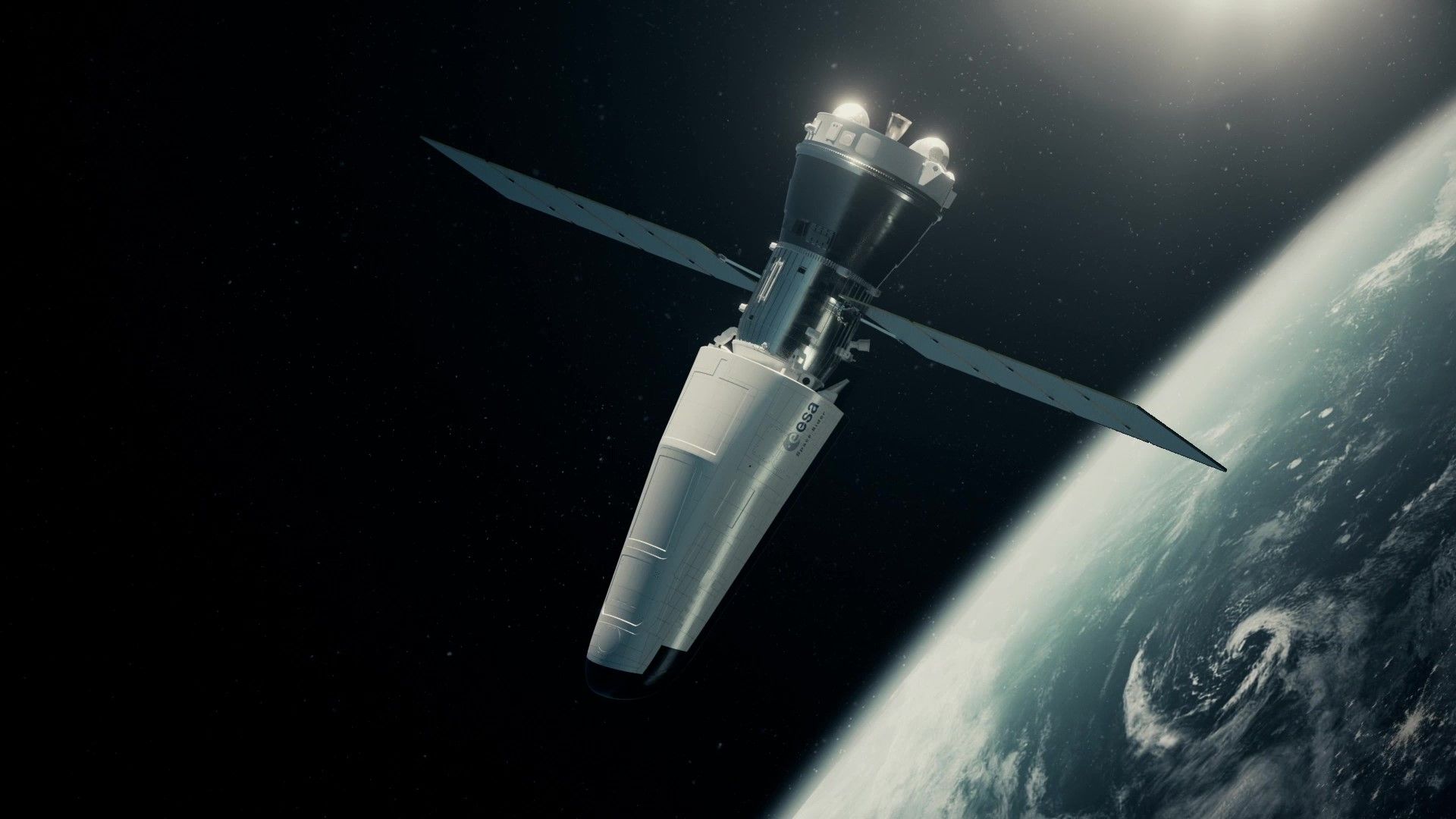
This was not exactly what engineers had in mind when they performed Space Rider's drop test.
When you purchase through links on our site, we may earn an affiliate commission. Here’s how it works.
Europe has dropped the ball on the prototype for its first reusable spacecraft. Or, rather, the prototype itself was dropped — on purpose — but the outcome of its fall was not what engineers had hoped for.
The incident occurred during an Oct. 6 drop test of the full-scale Space Rider model, from the European Space Agency (ESA). The robotic vehicle's initial drogue parachute deployed successfully, but its main parafoil detached during deployment, leaving the prototype unable to slow its descent before crashing into the ground, according to ESA officials. The cause of the failure remains under investigation.
"Following several successful tests using representative vehicle masses, the latest system-level drop test in October was not completed as planned due to an anomaly during the parafoil deployment sequence," an ESA spokesperson confirmed in an email to Space.com. "An independent investigation is ongoing to determine its root cause and inform the next steps."
Space Rider is being developed as Europe's first reusable orbital spacecraft — an uncrewed vehicle designed to carry scientific experiments to orbit for up to two months, then return them to Earth for analysis. Its method of return, though, differs from that of any other spacecraft in operation today. Space Rider''s wingless, lifting-body design relies on a steerable parachute, or parafoil, to maneuver toward its landing area. This allows it to perform runway-style touchdowns, as opposed to other, less accurate parachute-aided recoveries in current practice.
This month's drop test was intended to demonstrate that ability, which is a critical requirement for Space Rider's planned reuse after missions in orbit, but the impact of its failure may not end up disrupting its ultimate development timeline. According to Géraldine Naja, ESA's director of space transportation, the vehicle's other remaining qualification tests aren't holding back its path to launch.
"We hope that this test will not damage, or let's say lead us to modify, the remaining schedule and qualification activities," Naja said during an ESA Council media briefing on Oct. 22. "In any case, the remaining qualification activities are not on the critical path of the development of the Space Rider."
Naja described the incident as an unfortunate but important event. "We have had many successful tests before, but testing and validation is part of the development of a space system," she said.
The lost vehicle was a full-scale test model assembled to evaluate Space Rider's descent and landing systems. The minivan-sized mockup reproduced the size and flight characteristics of its reentry module, with avionics to control its autonomous guidance and navigation systems, but the vehicle was far from a space-ready article.