// NATURE NEWS — SPAZIO & SCIENZA
Elizabeth Holmes film enthralls — but her legacy haunts science
Search author on:
PubMed
Google Scholar
Search author on:
PubMed
Google Scholar
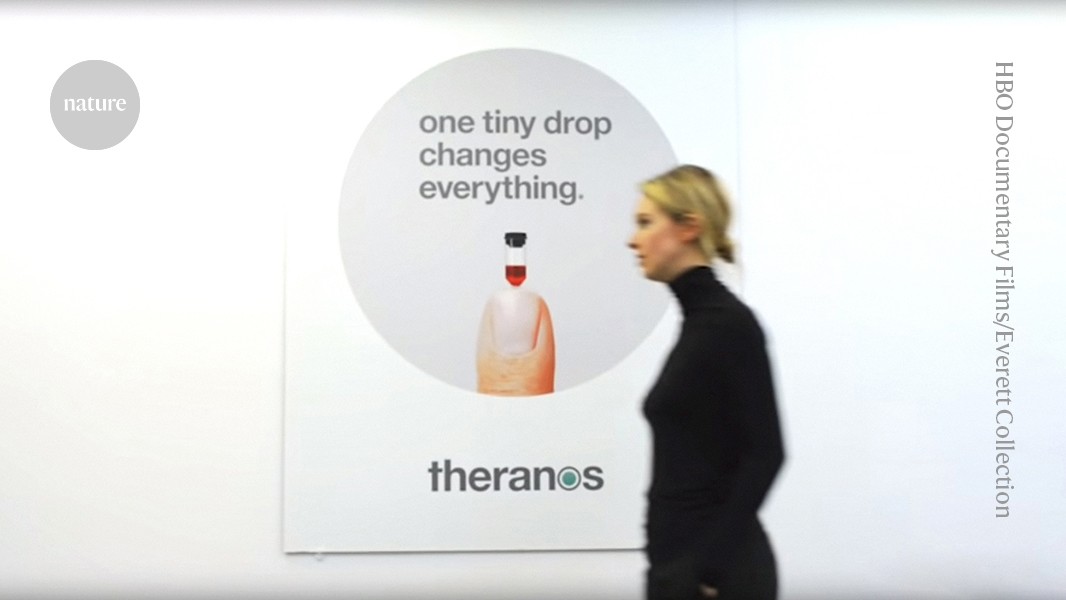
Theranos, the failed blood-testing company founded by Elizabeth Holmes, claimed that its device could run hundreds of tests on a few drops of blood.Credit: HBO Documentary Films/Everett Collection
You Can See Everything chronicles the final weeks before disgraced entrepreneur Elizabeth Holmes went to prison in 2023. Since its US release last week, the film has thrust Holmes and her failed blood-testing start-up, Theranos, back into the spotlight. For the biotechnology industry, however, the spectre of Theranos never went away.
Blood, sweat and tears in biotech — the Theranos story
More than a decade after the company’s spectacular collapse, a new generation of diagnostics firms still grapples with the fallout. During the 2010s, Theranos said that its device could run hundreds of tests on only a few drops of blood, drastically reducing the amount of fluid needed for routine diagnostics. The company’s success soared as investors backed the technology, but US federal juries later ruled that Theranos had misled those financial supporters about its device’s capabilities, and two of its executives, including Holmes, were sentenced to more than a decade in prison.
Today, health-tech companies are still developing devices similar to the ones that Theranos aspired to make. The firms say that Theranos’s demise underscored the importance of transparency in their pursuit. “Trust in diagnostics has to be earned through evidence and not promises,” says Dena Marrinucci, co-founder of Truvian Health, a diagnostics company in San Diego, California.
Theranos left “a crater in the whole field of monitoring and diagnostics”, says Paul Yager, a bioengineer and diagnostics developer at the University of Washington in Seattle. For years after its collapse, he says, researchers pitching blood-testing technologies faced the same opening question in every meeting: “How is what you’re trying to do different from what Theranos did?”
Standard diagnostic tests, which can measure everything from the levels of basic minerals — or electrolytes — to hormones in the blood, typically require several vials of fluid drawn from a person’s arm to ensure a large, homogeneous sample. The results can be used to diagnose and track various health conditions.
Theranos, which was based in Palo Alto, California, claimed that its Edison device could execute hundreds of diagnostic tests on just a few drops of blood from a finger prick. But behind the scenes, the company was having a hard time making the platform work as advertised, and instead resorted to diluting patient samples and running them on standard blood-testing machines from other companies, in some cases producing skewed measurements.