// SPACE.COM — SPAZIO & SCIENZA
'Donnie Darko' at 25: How a giant rabbit, time loops, and teen angst became a sci-fi cult classic
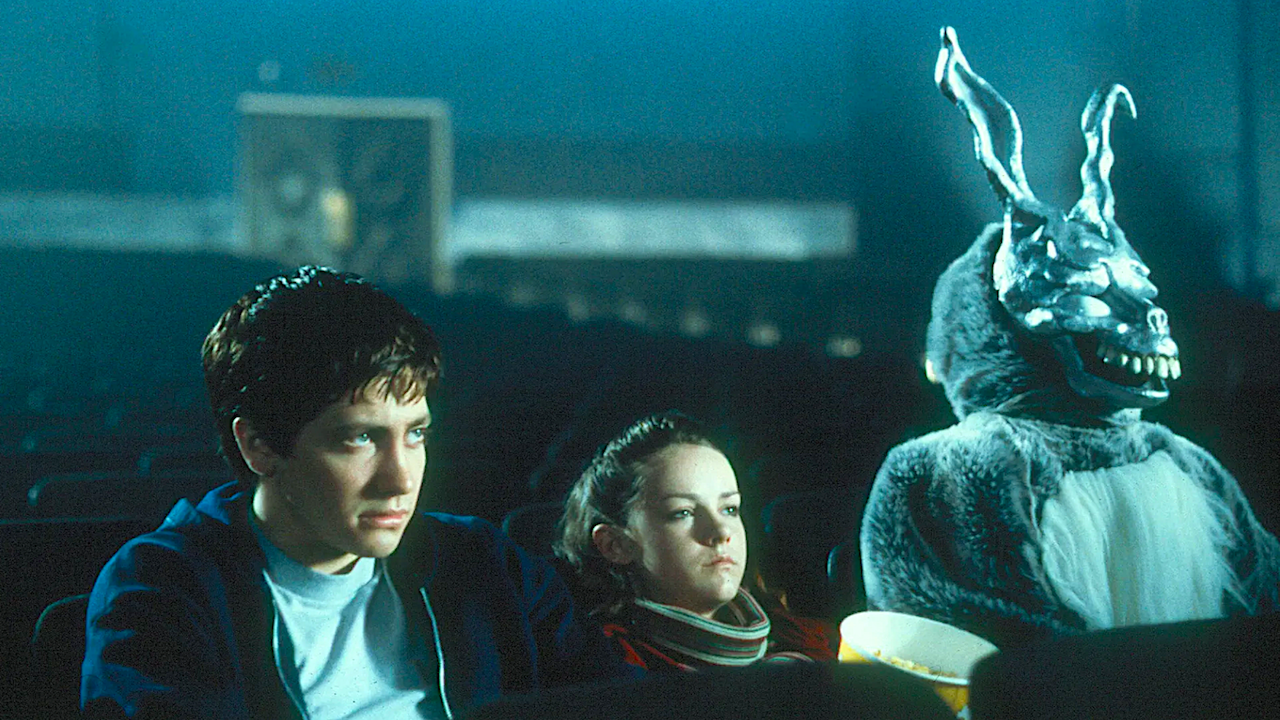
"28 days, 6 hours, 42 minutes, 12 seconds. That is when the world will end."
When you purchase through links on our site, we may earn an affiliate commission. Here’s how it works.
The term "cult classic" has been loosely bandied about in cinematic circles until its definition has diluted into nothingness, but never has it been more appropriately applied than to director Richard Kelly’s strange psychological sci-fi thriller, "Donnie Darko", which celebrates its milestone 25th birthday today.
Starring Jake Gyllenhaal, Drew Barrymore, Mary McDonnell, Maggie Gyllenhaal, Patrick Swayze, Jena Malone, and Noah Wyle, "Donnie Darko" was released on Oct. 26, 2001, into an unstable world still shocked by the catastrophic Sept. 11 terrorist attacks less than two months earlier.
The thrust of the narrative revolves around an alternative universe accidentally forming via a supernatural anomaly after a jet engine falls off a commercial airliner and crashes through the roof of a suburban Virginia home, landing in the bedroom of our troubled title character.
As the frightening phantom of Frank the Bunny warns, this parallel reality has a ticking clock that’ll result in its imminent collapse in just 28 days, 6 hours, 42 minutes, and 12 seconds.
From the haunting voice telling our heroic teen, "Wake up, Donnie," as the grandfather clock in the Darko residence ominously chimed midnight, to its exploration of the nature of mental illness, time travel paradoxes, fraudulent motivational speakers, teenage angst in the 1980s, and the logistics of interdimensional portals, "Donnie Darko" became an ideal parable for turbulent times.
But Kelly's post-modern sci-fi fantasy emerged on the big screen when there existed a pervading fear of gathering in large groups as America was just beginning to recover and process the atrocities committed on 9/11. Newmarket Films was perplexed on precisely how to market the movie, as it is such a unique combination of genres that forges something far greater than the sum of its parts.
Throughout that entire fall, "Donnie Darko" came and went in multiplexes with barely a whisper, pulling in just over $500K off of a meager $4.5 million budget. Years later, it would become a bona fide word-of-mouth sensation via several re-releases, home video editions, and further experiences in regularly sold-out midnight screenings on its way to earning cult status.
It's a deeply personal film that will affect any viewer who allows its meticulously slow build to seduce them into its dreamlike sphere. Much has been debated and discussed about its many metaphors and symbolism, which employed elements of a splintered universe long before the multiverse was hijacked by Hollywood superhero spectacles. It’s a raw meditation on death more than anything, and its labyrinth of quantum entanglements feeds our existential core.