// NATURE NEWS — SPAZIO & SCIENZA
Revered NASA spacecraft is about to perish in flames — astronomers are mourning
Jenna Ahart is a science journalist based in Washington DC.
Search author on:
PubMed
Google Scholar
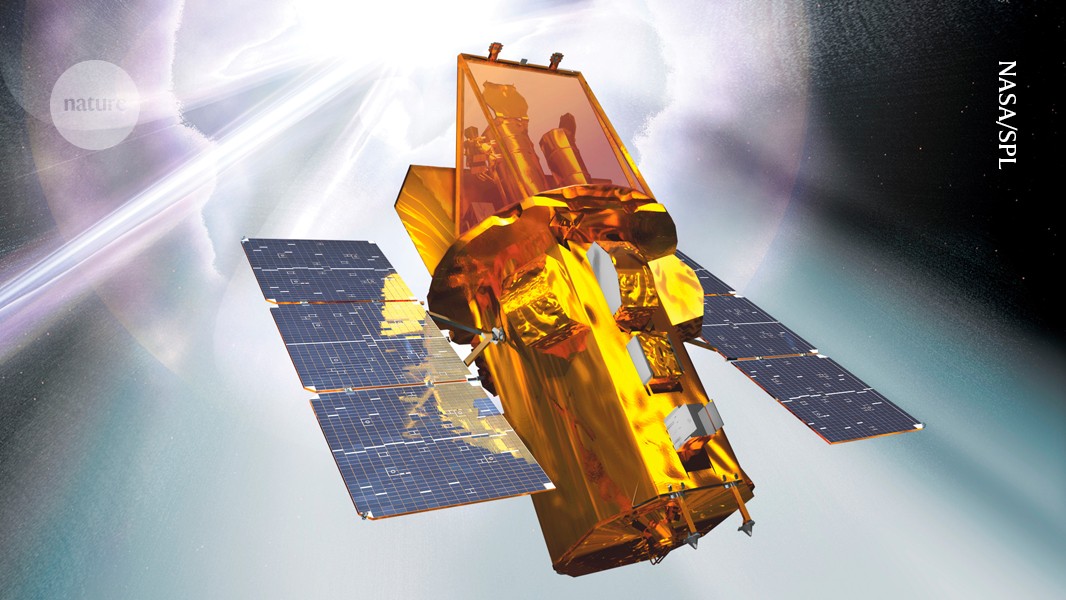
The Swift observatory was designed to observe the brilliant explosions called gamma ray bursts (artist’s illustration) but branched out to study black holes, supernovae and comets.Credit: NASA/Science Photo Library
A lauded NASA space observatory that has made countless discoveries far beyond its assigned portfolio will plummet to a fiery demise in Earth’s atmosphere next week, after a rescue attempt went awry.
Having spent almost 22 years in orbit, NASA’s Neil Gehrels Swift Observatory has been slowly losing altitude over time, but now it must fully succumb to its doom. In July, a spacecraft blasted off on a mission to boost Swift out of danger. But the rescue mission began to spin uncontrollably before reaching its target. Eventually Swift drifted so low that it could not lock onto its astronomical targets, and last week, NASA shut off science operations ahead of its impending skyfall.
Long-sought signal deepens mystery of fast radio bursts
Astronomers are mourning the spacecraft, which has had a glittering career observing everything from black holes to gamma-ray bursts, the most powerful explosions in the Universe. “We're all definitely very sad. There's definitely grief,” says Caryl Gronwall, Swift’s science operations team lead at The Pennsylvania State University in University Park. Swift’s end of operations has been especially “dramatic and tragic,” adds Hannah Earnshaw, an astronomer at the California Institute of Technology in Pasadena. Some researchers predict Swift will re-enter Earth’s atmosphere on 2 November. The majority of the observatory will burn up, likely leaving a small amount of debris to crash into the ocean.
Swift was originally dedicated to observing gamma-ray bursts, incredibly luminous and short-lived flashes of high-energy radiation. Swift has identified almost 2,000 of these bursts and helped to determine that some occur when two neutron stars — the ultra-dense cores of dead stars — slam into each other. In 2017, Swift also observed the aftermath of one especially momentous neutron-star collision to help to show that these events synthesize heavy elements such as gold and platinum.
What might be most impressive about Swift’s career, however, is all its extracurricular science. It observed supernovae and comets and shed light on how black holes produce powerful jets when they swallow stars. The observatory’s “science portfolio evolved and grew well beyond what it was initially designed to do,” says Brad Cenko, Swift’s principal investigator at NASA’s Goddard Space Flight Center in Greenbelt, Maryland.
Surprise! White dwarf stars come in a rainbow of colours