// NATURE NEWS — SPAZIO & SCIENZA
Delayed electron–hole recombination in a pseudo-direct semiconductor
Nature
(2026) Cite this article
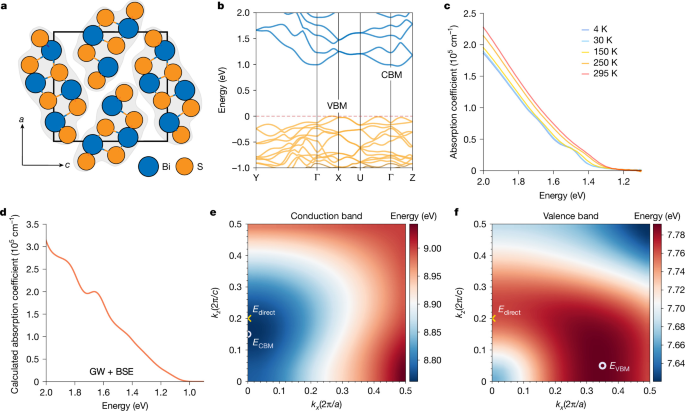
Kirchhoff demonstrated the reciprocity between absorptivity and emissivity for blackbody radiation in 1860 (ref. 1), thereby establishing the general principle that a good absorber must also be a good emitter. This principle underpins the generalized Planck’s law2 and, when applied to semiconductors—in the form of the van Roosbroeck–Shockley equation3—results in substantial limitations to solar energy conversion. Here we demonstrate how this reciprocity can be circumvented in semiconductors, such as bismuth sulfide, showing a pseudo-direct bandgap character—that is, featuring a lower-energy indirect transition paired with a direct transition placed a few kBT above. After determining the pseudo-direct bandgap nature of bismuth sulfide, we reveal how this feature substantially retards bimolecular electron–hole recombination in this material with respect to classic direct semiconductors4. The resulting combination of a high absorption coefficient and delayed recombination offers the unprecedented possibility of overcoming limitations associated with Planck’s law, with far-reaching potential for solar energy conversion.
Charge-carrier recombination in semiconductors is a fundamental process determining device efficiencies for a variety of key optoelectronic applications, ranging from photovoltaics5,6 to light-emission7,8 and photo(electro)catalysis9,10. Several intrinsic (for example, bimolecular) and extrinsic (for example, trap-mediated) recombination mechanisms contribute to charge-carrier recombination in light-harvesting devices such as photovoltaic and photochemical cells, in which recombination competes with charge-carrier extraction5,6,11 and thus causes efficiency losses. For any solar absorber material, minimizing extrinsic recombination losses is therefore a powerful first-line strategy to increase power conversion efficiencies12, with any remaining intrinsic losses defined by the detailed balance limit. For example, the benign defect chemistry of lead halide perovskites13 and the use of molecular passivation strategies12 have achieved trap-mediated recombination rates as low as k1 ≈ 105 s−1 (refs. 7,8). As a result, power conversion efficiencies of perovskite solar cells now reach values of about 28% (ref. 14). Similarly, more established technologies based around silicon or III–V semiconductors are reaching their intrinsic performance limits14,15 in solar devices.
These rapid developments mean that further minimization of charge-carrier recombination is now mostly hampered by Planck’s law, which sets inherent limitations to the reduction of intrinsic bimolecular electron–hole recombination rates4,16. In lead halide perovskites, similar to GaAs and Si, the intrinsic bimolecular recombination process of photogenerated electrons with holes is an inverse absorption process and has been demonstrated to follow the van Roosbroeck–Shockley (vRS) relation closely3,4,17,18. Therefore, the high bimolecular recombination rates reported for lead halide perovskites (LHP) and GaAs11,19 (k2,LHP ≈ 10−9 cm3 s−1, k2,GaAs ≈ 10−10 cm3 s−1) are a direct consequence of their direct bandgap character and the ensuing high absorption coefficients, which, taken on their own, are a desirable property for solar absorber materials. However, the associated high bimolecular recombination rates severely limit applications of perovskites and other highly absorbing semiconductors not only in solar cells but also in photoelectrocatalytic cells9,10. In these applications, extended charge-carrier lifetimes at semiconductor–electrolyte interfaces are vital for solar energy conversion to chemicals20.
Although the generalized Planck’s law sets a strict dependency between absorption and charge-carrier recombination efficiencies, these considerations apply only when both these processes originate from the same electronic state3. Decoupling light absorption and charge-carrier recombination process