// NATURE NEWS — SPAZIO & SCIENZA
Perinatal elimination of genetically aberrant human cortical neurons
Nature
(2026) Cite this article
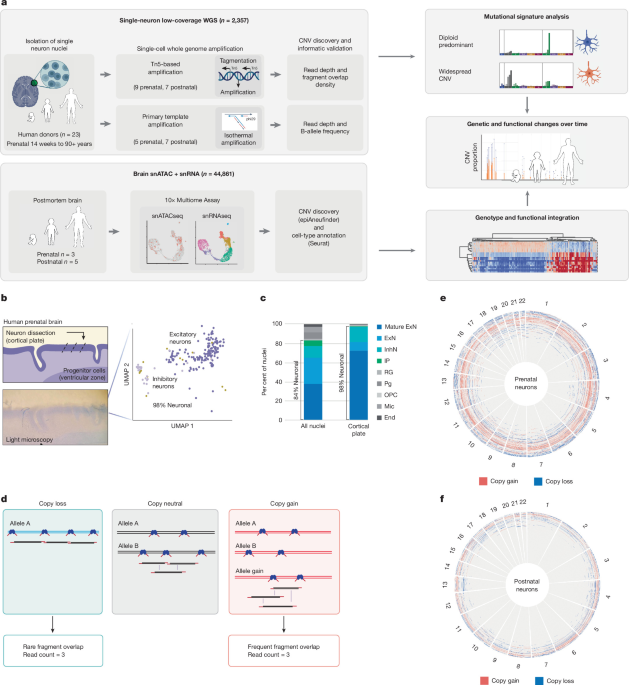
Human neurons are postmitotic and long-lived, requiring precise genomic regulation. Normal neuronal function is highly dosage-sensitive, with copy number variants (CNVs) and heterozygous point mutations associated with a host of neurodevelopmental and neuropsychiatric conditions1,2,3,4. Here we investigated somatic CNVs arising in single neurons to understand the dynamic processes that shape the normal neuronal genetic landscape. Altogether, we sequenced 2,357 single neurons from human postmortem brain from fetal to postnatal life. Two single-cell whole-genome sequencing approaches—Tn5-transposase-based amplification (1,526 neurons, 16 individuals) and primary template amplification5 (831 neurons, 12 individuals)—showed that an average of 25.9% [12.7–46%] of prenatal cortical neurons have highly aberrant genomes, that is, widespread CNVs involving multiple chromosomes. This proportion reduced by about 4.5-fold after birth across the two single-cell whole-genome sequencing approaches (Fisher meta-analysis P = 3.5 × 10⁻⁶). Neurons with widespread CNVs were mainly eliminated perinatally, timed roughly parallel to periods of programmed cell death6, whereas neurons with smaller CNV burdens declined slowly in frequency with postnatal age. CNVs in surviving neurons were depleted for dosage-sensitive genes and genes involved in neurodevelopmental disorders (hypergeometric test P < 0.05), suggesting selective elimination of neurons with these CNVs. Analysis of 44,861 nuclei with single-nucleus assay for transposase-accessible chromatin (snATAC) and single-nucleus RNA sequencing (snRNA-seq) showed that neurons with high CNV burdens exhibited abnormal synaptic gene expression, suggesting that abnormal synaptic gene regulation contributes to neuronal elimination. Elimination of defective neuronal genomes might represent an important developmental genome quality-control process that may be vulnerable in neurodevelopmental disease, and suggests purifying selection during human neurodevelopment.
Chromosome-scale CNVs are common in early post-zygotic development, with up to 73% of embryos exhibiting large chromosomal aneuploidy in some cells 7,8,9. Similarly, human neural progenitor cells (NPCs) exhibit extensive mosaic aneuploidy, involving up to 30% of progenitors10. Rates of aneuploidy in adult neurons have been controversial, with some reports of widespread aneuploidy11, whereas other reports suggest rare aneuploidy12,13,14,15,16 or frequent, predominantly sub-chromosomal CNVs14,17,18. These discrepancies arise from differences in methodology and the sensitivity of techniques, making it unclear whether the high aneuploidy rates observed early in development are maintained through to adulthood in the brain.
The control of copy number is especially crucial in the brain, because genetic variation in neurons can have profound functional impact. Autism, schizophrenia, epilepsy, intellectual disability and other neuropsychiatric conditions are all commonly caused by chromosomal or sub-chromosomal CNVs, as well as by heterozygous loss-of-function point mutations in more than 1,000 genes that are essential for brain functions1,2. Many of these genes encode structural proteins of the synapse or regulators of synaptic plasticity, suggesting that key aspects of neuronal plasticity underlying these conditions are intensely sensitive to gene dosage19,20,21.
Although a variety of cell-cycle checkpoints regulate progenitors to prevent genomic abnormalities or eliminate cells harbouring them6,11,22, it is not clear whether any such pathways exist to control gene dosage in noncycling cells such as neurons. One hypothesis suggests that genetically aberrant neurons are eliminated through programmed cell death6,23, a form of widespread apoptosis, which, in human cerebral cortex, is estimated to remove anywhere from 20% to 50% of neurons during development24. In all examined mammalian species, t