// NATURE NEWS — SPAZIO & SCIENZA
Connectome simulations identify a central pattern generator for fly walking
Nature
(2026) Cite this article
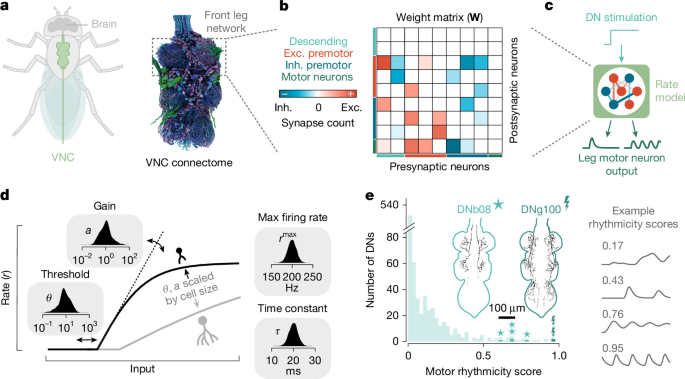
Animal locomotion relies on rhythmic body movements driven by central pattern generators (CPGs): neural circuits that produce oscillating output without oscillating input. However, the circuit structure of a CPG for walking is not known in any animal1,2. To identify the cells and synapses that underlie rhythmic leg movement in walking flies, we developed dynamic simulations of the Drosophila ventral nerve cord connectomes3,4,5,6. A computational activation screen of descending neurons from the central brain identified DNg100—a known command neuron for walking—as the strongest driver of rhythmic leg motor activity. Simulated network pruning isolated a minimal rhythm-generating circuit consisting of one inhibitory and two excitatory interneurons; this three-neuron circuit was necessary and sufficient for motor rhythms across all six legs and in four connectome datasets. Simulations also predicted that a separate descending pathway (DNb08) drives rhythmic leg movements, which we confirmed experimentally using optogenetics in behaving flies. Our results reveal the cellular identity and synaptic structure of a putative CPG circuit for walking and other rhythmic leg movements in flies.
This is a preview of subscription content, access via your institution
Access Nature and 54 other Nature Portfolio journals
Get Nature+, our best-value online-access subscription
Prices may be subject to local taxes which are calculated during checkout
Connectome data were taken from the publicly available datasets referenced throughout3,4,5,6. MANC connectome data were analysed from the public release (v.1.2.1). FANC connectome data were analysed from the CAVE materialization (v.1178; timestamp 2025-01-07T10:10:01.373080). Male CNS connectome data were analysed from the public release (v.0.9). BANC connectome data were analysed from the CAVE materialization (v.829; timestamp 2026-02-13T08:10:01.234098). All connectivity and cell information for the exact subnetworks used in this paper are provided at https://github.com/smpuglie/Pugliese_2026. Simulation output data and Anipose data can be found on Zenodo via https://doi.org/10.5281/zenodo.22260923.
Code to run the connectome simulations and notebooks to reproduce the analyses in each figure are available on GitHub at https://github.com/smpuglie/Pugliese_2026.
Büschges, A. & Ache, J. M. Motor control on the move: from insights in insects to general mechanisms. Physiol. Rev. 105, 975–1031 https://doi.org/10.1152/physrev.00009.2024 (2025).
Article
PubMed
Google Scholar