// NATURE NEWS — SPAZIO & SCIENZA
Rare and common genetic variants shape single-cell immune gene expression
Nature
(2026) Cite this article
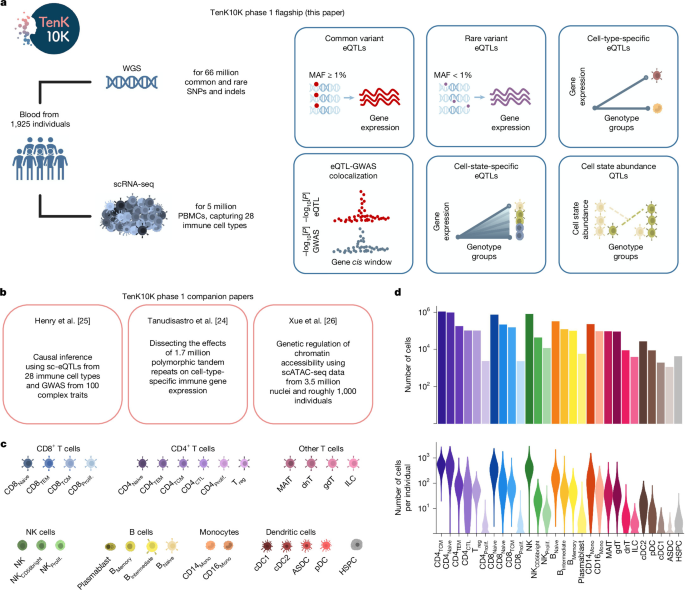
Understanding the genetic basis of gene expression can shed light on the regulatory mechanisms underlying complex traits and diseases1,2. Single-cell-resolved measures of RNA levels and single-cell expression quantitative trait loci have revealed genetic regulation that drives cell states and types across diverse tissues3. Here we describe phase 1 of TenK10K, which leverages single-cell RNA sequencing data from more than 5 million cells across 28 immune cell types, along with matched whole-genome sequencing data from 1,925 individuals. This provides power to detect associations for rare and low-frequency genetic variants that have largely been uncharacterized in their impact on cell-specific gene expression. We map the effects of both common and rare variants in a cell-type-specific manner using a recent method that increases power by modelling single cells directly rather than aggregated ‘pseudobulk’ counts. We identify putative common regulatory variants for 83% of all 21,404 genes tested and cumulative rare-variant signals for 47% of those genes. We explore how genetic effects vary across cell types and states, develop a framework to determine the degree of single-cell expression quantitative trait loci cell-type specificity and show that about half of the effects are observed only in one or a few cell types. By integrating our results with functional annotations and disease information, we further characterize the likely molecular modes of action for many disease-variant associations. Finally, we explore the effects that genetic variants have on gene expression across continuous cell states, and effects that vary cell-state abundance directly.
Genome-wide association studies (GWASs) have revealed hundreds of thousands of association signals between genetic variants and human diseases and traits4, but the modes of action by which most of these variants affect phenotypes remain to be characterized, especially non-coding variants. The characterization of the impact of genetic variants on gene expression—known as expression quantitative trait locus (eQTL) mapping—can help linking variants to the putative genes they regulate1,5,6,7,8,9, thus identifying the genes and pathways involved in disease pathogenesis, which is a critical step in identifying opportunities for therapeutic intervention10.
However, important limitations remain. First, eQTL mapping has traditionally been limited to common genetic variation (minor allele frequency (MAF)) greater than 1–5%) due to relatively small sample sizes and the widespread use of genotyping arrays, which do not accurately genotype most rare variants and complex structural variants11, compared with whole-genome sequencing (WGS) approaches. Second, eQTLs are extremely context specific, with many studies demonstrating that genetic variants frequently affect gene expression levels in ways detectable only in specific tissues3, sorted cell types6,10,12,13 or on stimulation14,15. Single-cell eQTL mapping has further demonstrated that the effects of many genetic variants on gene expression can only be detected within specific cell types and even transient cellular states3,16,17,18,19,20,21,22,23.
Here we introduce phase 1 of the TenK10K (up to 10,000 cells for 10,000 individuals) study, encompassing 5.4 million cells from 1,925 individuals of European ancestry selected from a broader cohort of 2,103 individuals. In accompanying papers, we leverage the same dataset to investigate the effect of tandem repeat variation on gene expression24 and the putative causal links between gene expression measurements and human diseases and traits25, and an overlapping set of samples to explore the impact of genetic variation on chromatin accessibility26.
Here we use an association method we recently developed, SAIGE-QTL27, to map common-variant and rare-variant single-cell eQTLs across immune cell types. We identify more than 150,000 common-vari