// NATURE NEWS — SPAZIO & SCIENZA
Time-reversal-symmetry-breaking spin injection from a compensated magnet
Nature
(2026) Cite this article
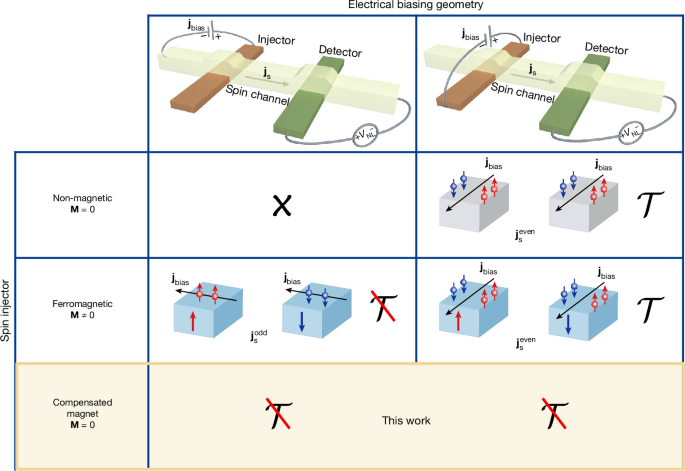
The generation and transport of spin currents are central to spintronics, a technologically relevant field in which information is carried and manipulated using the electron spin rather than solely the electrical charge. Conventionally, electrical spin injection and the separation of charge and spin currents rely either on ferromagnets1,2,3,4,5,6,7,8,9,10, in which spin polarization originates from a net magnetization, or on relativistic effects such as the spin Hall effect11,12,13,14,15,16. Here we demonstrate spin injection from Mn5Si3, a compensated magnet with vanishing net magnetization. Using lateral spin-valve devices, we electrically inject spins from Mn5Si3 into a non-magnetic channel and detect their propagation at a spatially separated ferromagnetic electrode. Switching between time-reversed magnetic states of Mn5Si3 reverses the detected spin signal, demonstrating that the spin injection breaks time-reversal symmetry. This behaviour is observed for two distinct electrical-biasing geometries, providing a characteristic signature that differs from conventional ferromagnetic and spin-Hall injection. Symmetry analysis, first-principles calculations and spin-transport modelling show that our observations are consistent with the altermagnetic order of Mn5Si3, in which spin-polarized currents can arise despite the absence of net magnetization17,18,19,20,21. The calculations yield spin polarizations of 6.5–10%, comparable to those of conventional ferromagnets, whereas the spin-transport modelling of the experiments indicates spin diffusion lengths of 50–130 nm. Our results provide experimental evidence that a compensated magnet can generate spin currents controlled by its magnetic order and demonstrate that the altermagnetic properties of Mn5Si3 enable spintronic functionality without net magnetization.
This is a preview of subscription content, access via your institution
Access Nature and 54 other Nature Portfolio journals
Get Nature+, our best-value online-access subscription
Prices may be subject to local taxes which are calculated during checkout
The data supporting the findings of this study are available in the Article and its Supplementary Information. Extra data are available from the corresponding author on request. Source data are provided with this paper.
Johnson, M. & Silsbee, R. H. Interfacial charge-spin coupling: injection and detection of spin magnetization in metals. Phys. Rev. Lett. 55, 1790–1793 https://doi.org/10.1103/PhysRevLett.55.1790 (1985).
Article
ADS
CAS
PubMed
Google Scholar
Jedema, F. J., Filip, A. T. & van Wees, B. J. Electrical spin injection and accumulation at room temperature in an all-metal mesoscopic spin valve. Nature 410, 345–348 https://doi.org/10.1038/35066533 (2001).