// NATURE NEWS — SPAZIO & SCIENZA
Genetic variants shape single-cell chromatin accessibility and disease risk
Nature
(2026) Cite this article
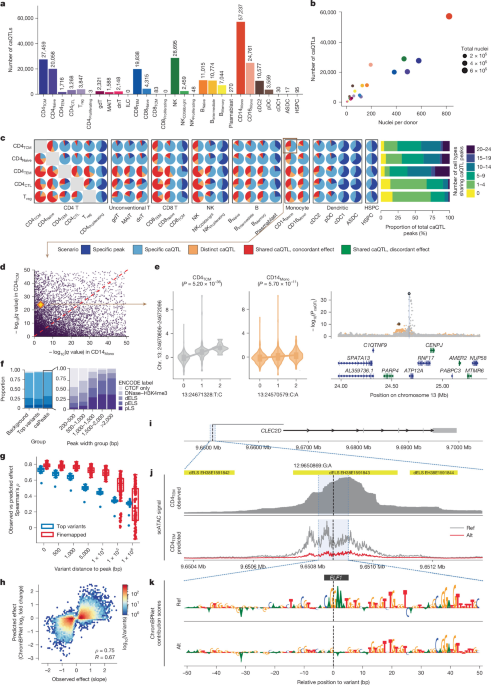
Understanding how genetic variation shapes gene regulation at single-cell resolution is crucial for elucidating complex disease mechanisms1, but has been limited by the lack of large-scale single-cell multi-omics data2,3,4. Here we present single-cell assay for transposase-accessible chromatin with sequencing of 3.5 million peripheral blood mononuclear cells from 1,042 donors with matched whole-genome sequencing. Across 28 immune cell types, we tested 440,996 chromatin accessibility peaks and identified 243,225 chromatin accessibility quantitative trait loci (caQTLs) at 100,483 peaks, 60% of them cell-type specific. Rare variant analysis identified 38,161 associated peaks, with predicted transcription factor-binding disruption implicated at individual loci. Colocalization with expression QTLs (eQTLs) from single-cell RNA sequencing data (5.4 million peripheral blood mononuclear cells)5 defined 28,834 candidate cis-regulatory elements. Across genome-wide association studies for 16 diseases and 44 blood traits, caQTLs colocalized 4.5–22.6% more signals than eQTLs alone. Cell-type-specific and tissue-specific context, distal effects and multi-causal-variant models raised genome-wide association study–eQTL concordance from approximately 16% to approximately 65%. Cell state further modulates genetic effects, with 27% of over 200,000 caQTL–cell-state interactions lacking a main effect. At the inflammatory bowel disease risk gene ADCY7, accessibility effects varied with genotype and G protein-mediated pathway activity in CD4+ T cells. A graph neural network trained on both eQTL and caQTL layers inferred peak–gene links in unpaired multiome data with up to 17.2% higher accuracy than QTL-agnostic data, uncovering 128 additional transcription factor–target pairs (22% increase). Together, these results show that genetic variants shape chromatin accessibility in a cell-type-specific and cell-state-specific manner, influencing immune function and disease risk.
Understanding how genetic variation influences complex traits and disease risk remains a major challenge in human genomics. Although genome-wide association studies (GWAS) have identified tens of thousands of risk loci, most lie in non-coding regions6, complicating interpretation. One common approach to bridge this gap is to map molecular QTLs (molQTLs), identifying genetic variants that affect intermediate molecular phenotypes such as gene expression or chromatin accessibility, and then test for colocalization with GWAS loci to infer potential regulatory mechanisms7. Most molQTL studies have focused on eQTLs derived from bulk RNA sequencing (RNA-seq), which have low sensitivity for cell-type-specific effects8,9. Recently, well-powered single-cell RNA-seq (scRNA-seq) studies have shown that genetic regulation of gene expression varies across cell types and states10,11,12,13,14. However, many GWAS signals still lack corresponding regulatory effects, a gap often termed the ‘missing regulation’ problem15,16,17.
caQTLs offer a complementary modality that directly reflects the physical state of regulatory elements and captures non-coding variant effects on enhancer and promoter activity. Recent studies have suggested that caQTLs colocalize with more GWAS loci than eQTLs15,16,18,19, particularly at distal elements, but current caQTL maps remain limited in scale or resolution20,21, or rely on genotypes imputed from the chromatin data22. Many caQTLs also lack corresponding eQTLs for reasons that remain unclear16,23, and dynamic, cell-state-dependent regulatory effects are often overlooked11,24.
Here we present a large-scale atlas of genetic effects on single-cell chromatin accessibility in peripheral blood mononuclear cells (PBMCs). We profiled over 4.6 million single-cell assay for transposase-accessible chromatin with sequencing (scATAC-seq) and 95,728 multiome (RNA + ATAC) nuclei across 1,042 individuals. After quality contr