// SPACE.COM — SPAZIO & SCIENZA
On this day in space! Nov. 5, 2002: NASA's Galileo spacecraft flies by Jupiter moon Almathea only to find it's a 'pile of icy rubble less dense than water'
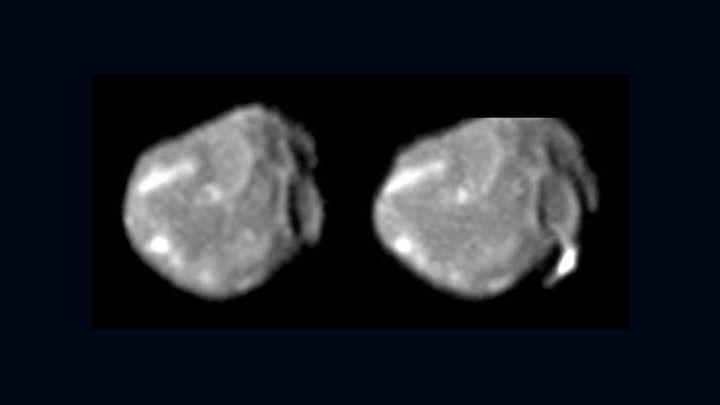
The Galileo spacecraft was running on cosmic fumes by the time it reached Amalthea and the flyby would be a last of its kind.
When you purchase through links on our site, we may earn an affiliate commission. Here’s how it works.
On Nov. 5, 2002, NASA's old Galileo spacecraft was almost out of fuel. But the Jupiter mission still had some science to do. Galileo flew by a small moon called Amalthea. Amalthea is small, but it's interesting for scientists.
The Jupiter moon Amalthea is the reddest object in our solar system. It also generates more heat than it gets from the sun. Scientists think Amalthea creates electrical currents as it orbits in Jupiter's huge magnetic field. Near this little moon, strong radiation from Jupiter is dangerous for spacecraft.
The flyby caused some problems for Galileo. The spacecraft went into safe mode only 30 minutes after going past Amalthea. NASA said it was ready for problems, because Galileo was on its last legs, and the radiation near Amalthea was strong. However, NASA quickly fixed the problem and got Galileo working again.
Less than a year later, Galileo threw itself into Jupiter's atmosphere. The spacecraft was crushed by the high pressure in Jupiter's atmosphere, but its data still survives on Earth.
The Galileo spacecraft was running on cosmic fumes by the time it reached Amalthea and the flyby would be the last time the probe would ever swing by one of Jupiter's moons.
While it may not look like it in Galileo's black and white images above and below, Amalthea is tinted red due sulfur contamination on its surface. The moon is small, about 168 miles long, and orbits about 112,468 miles (181,000 km) from Jupiter (much closer to the planet than the Earth and its moon).
Galileo flew within 99 miles of Amalthea during its flyby, which also marked the closest Galileo would get to Jupiter before its death dive in September 2005.
"Scientists studying data from NASA's Galileo spacecraft have found that Jupiter's moon Amalthea is a pile of icy rubble less dense than water," NASA announced in May 2005