// SPACE.COM — SPAZIO & SCIENZA
NASA's new UVEX space telescope will peer deep into the universe's most violent events
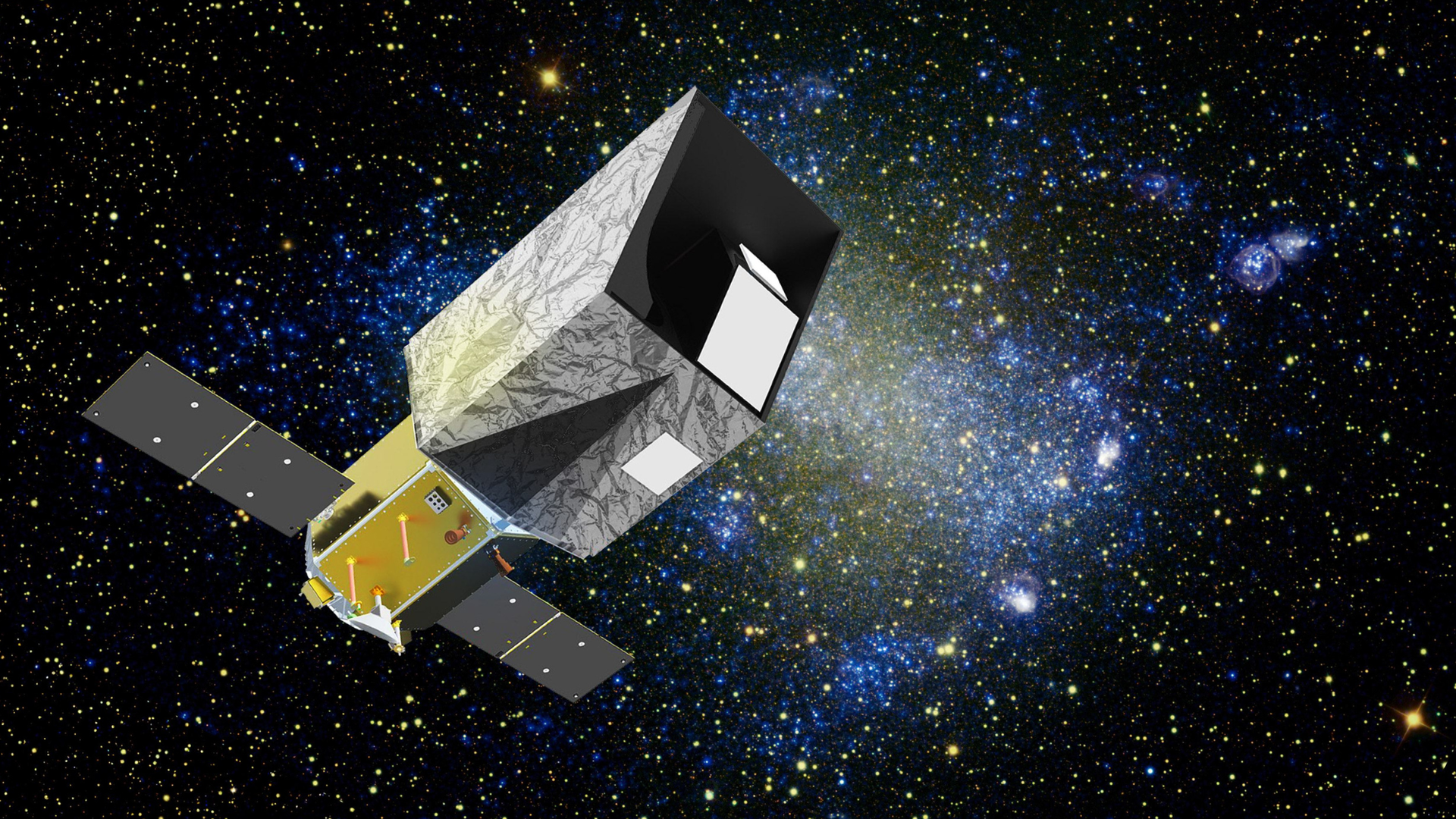
The UVEX mission will "advance fundamental frontiers in astrophysics, from understanding the smallest galaxies to diagnosing the aftermaths of neutron-star mergers and other cosmic explosions."
When you purchase through links on our site, we may earn an affiliate commission. Here’s how it works.
A new NASA space telescope will study the universe in ultraviolet light to reveal the violent and turbulent events that bubble under what appears to be a cosmic sea of tranquility.
The Ultraviolet Explorer (UVEX) mission, developed by NASA in conjunction with the California Institute of Technology (Caltech), will be the first mission to create deep all-sky maps in ultraviolet light. Thus, when it launches in 2031, UVEX will join new sky-mapping surveys like NASA's SPHEREx (Spectro-Photometer for the History of the Universe, Epoch of Reionization and Ices Explorer), which scans the cosmos in infrared, and the Vera C. Rubin Observatory, which does the same over the southern hemisphere in visible light, in creating deep-sky maps across a broad swathe of the electromagnetic spectrum.
UVEX's ultraviolet views will reveal explosive events such as the collisions between ultra-dense stellar corpses called neutron stars and the supernova explosions that mark the deaths of massive stars and the births of neutron stars and black holes. Additionally, the NASA ultraviolet telescope should be able to detect a multitude of low-mass galaxies much closer to the Milky Way than similar galaxies that are currently being observed millions and even billions of light-years away by NASA's James Webb Space Telescope (JWST).
The $590 million UVEX mission will "advance fundamental frontiers in astrophysics, from understanding the smallest galaxies to diagnosing the aftermath of neutron-star mergers and other cosmic explosions," the mission's principal investigator, Caltech physics professor Fiona Harrison, said in an Oct. 27 statement.
"The first major ultraviolet space mission in two decades, UVEX is a bold leap forward in our exploration of the ultraviolet universe," Caltech President Ray Jayawardhana said in the same statement.
UVEX will benefit from a major leap forward in UV sensitivity thanks to its Caltech-built sensors, which are based on complementary metal–oxide–semiconductor (CMOS) imaging technology. This will help the spacecraft tap into what Harrison described as "the untapped opportunity in the UV."
UVEX will be uniquely poised to spot millions of nearby, small, and faint galaxies that are teeming with infant stars that emit bright UV light.
"In optical light, it's very hard to distinguish these nearby galaxies from faraway ones that look similar," Harrison said. "UV light will make them easier to find."