// NATURE NEWS — SPAZIO & SCIENZA
Human land use drives microplastic abundance in terrestrial wildlife
Nature
(2026) Cite this article
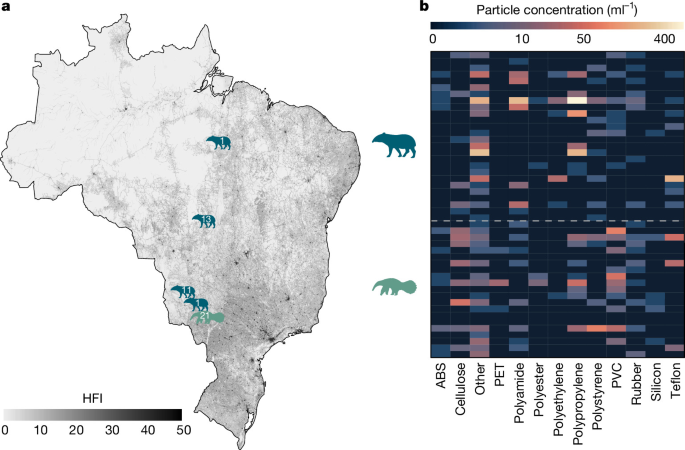
Plastic pollution is a defining feature of the Anthropocene1, and microplastics are dispersed by air and water into even remote terrestrial habitats2,3,4,5,6,7, yet the ecological and landscape-level processes that shape microplastic accumulation in terrestrial ecosystems remain poorly understood. Human land-use change is rapidly transforming landscapes worldwide, but the influence of this expanding human footprint on the microplastic burdens in wildlife remains largely unknown. This knowledge gap is particularly pressing in regions that are facing escalating environmental pressures, such as Brazil. Here we pair in vivo microplastic measurements with high-resolution tracking data from lowland tapirs and giant anteaters across Brazil and show that the microplastic burdens carried by free-ranging mammals increase with both the magnitude of their human footprint exposure and their proximity to development and waste management infrastructure. Microplastics were also detected in the blood of individuals occupying seemingly pristine habitats far from development, suggesting that direct exposure to human-modified landscapes is unlikely to be the sole driver of systemic microplastic burdens. In a period of accelerating global land-use change, these findings reveal how individual habitat use and anthropogenic land-use change interact to shape wildlife exposure to microplastics and suggest that managing animals’ proximity to development and waste management infrastructure may reduce the microplastic burdens carried by terrestrial wildlife.
Plastic pollution, once thought to be a predominantly aquatic issue, is increasingly being recognized as a threat to terrestrial ecosystems1. Microplastics (synthetic polymer particles with diameter less than 5 mm) are a particularly problematic form of plastic pollution, as these small particles are easily dispersed through pathways that include atmospheric deposition, precipitation, river transport and groundwater flow2,3,4,5,6,7. The high environmental mobility of microplastics has allowed them to infiltrate even the most pristine habitats8 where they can persist for centuries9,10. For wildlife exposed to microplastics, the small size and diverse chemistry of these particles facilitate ingestion11 and the penetration of biological membranes12,13. Once internalized, microplastics can bioaccumulate, biomagnify through food webs and pose severe health risks14,15,16,17,18.
Although much work has been done on detecting microplastics in different biological compartments (reviewed in ref. 19), studies in terrestrial ecosystems have largely been limited to descriptive surveys that document the presence of microplastics without investigating how these pollutants accumulate within wildlife20,21,22. Although such studies have proven informative for identifying the scope and scale of plastic pollution, this approach has left the bioaccumulation dynamics of microplastics in terrestrial environments poorly understood. As a result of this knowledge gap, even high-profile studies on plastic ingestion risk in wildlife have had to rely on assumptions about the relationship between individual habitat use and the uptake of microplastics rather than empirically grounded associations23. Because both sources and dispersal pathways for microplastics are amplified by land-use change24,25,26, the intensity of human landscape modification should have a key role in shaping the internal microplastic burdens of terrestrial wildlife. Whether this is the case, however, is still largely unknown. With the continuing expansion of human-modified landscapes into wild spaces27 and the concomitant increase in global plastic production28, there is an urgent need to move beyond presence/absence studies and towards understanding the ecological and landscape-level factors that shape microplastic burdens in terrestrial species29.
Here we integrate movement ecology, land-use dat