// NATURE NEWS — SPAZIO & SCIENZA
Domain-alteration chimeras rewire oncogenic complexes in prostate cancer
Nature
(2026) Cite this article
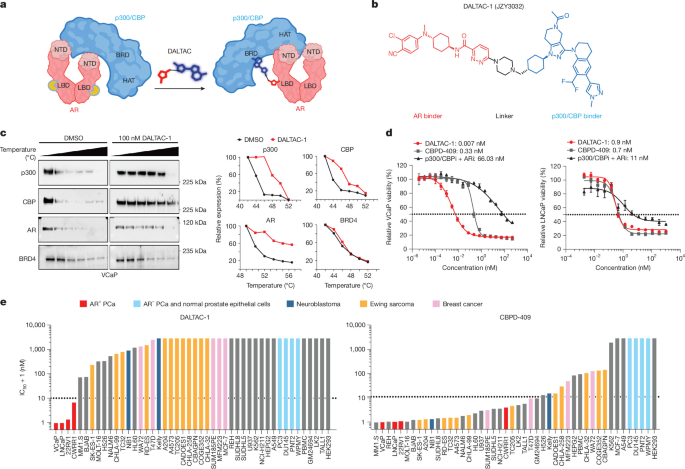
Transcriptional addiction to the androgen receptor (AR) underlies metastatic castration-resistant prostate cancer1, in which AR maintains oncogenic programs through domain-specific interactions with the acetyltransferases p300 and CBP (collectively p300/CBP)2. Here we describe a novel therapeutic modality, domain-alteration chimeras (DALTACs), that rewire endogenous protein complexes by enforcing non-native domain–domain interactions. Our first-in-class AR–p300/CBP DALTAC-1 induces synthetic proximity between the ligand-binding domain of AR and the bromodomain of p300/CBP, misconfiguring their native interface and locking the complex in a non-productive state. DALTAC-1 triggers a ‘super-inhibitory’ effect, suppressing AR-driven transcription and proliferation more potently than combined AR and p300/CBP inhibition. Mechanistically, DALTAC-1 reprograms p300/CBP substrate engagement, abolishing the histone mark H2B N-terminal acetylation and inducing neomorphic acetylation of AR and coactivators, ultimately collapsing the AR neo-enhanceosome. Chromatin profiling revealed redistribution of AR and p300/CBP towards palindromic androgen response elements, accompanied by disruption of cofactor and transcriptional machinery recruitment at oncogenic AR and ERG neo-enhancers. DALTAC-1 exhibits exquisite lineage selectivity, displaying potent activity in AR–p300/CBP dual-dependent cells and sparing AR-negative cells. In multiple in vivo models, DALTAC-1 induces deep and durable tumour regressions. Together, these findings establish DALTACs as a broadly applicable strategy to rewire disease-defining complexes through domain-topology alteration, expanding induced-proximity therapies, and the precise lineage selectivity of DALTAC-1 supports its translational potential in AR-driven prostate cancer.
Aberrant enhancer-driven transcription sustains many cancers, including metastatic castration-resistant prostate cancer (mCRPC)3,4. AR, a central driver of mCRPC, undergoes ligand-induced activation and dimerization upon binding to androgen response element (ARE)-enriched enhancers and assembling cancer-specific neo-enhanceosomes4,5,6. These complexes depend on the paralogous acetyltransferases p300 and CBP7. p300 has been identified as the predominant paralogue supporting AR-positive (AR+) prostate cancer growth, and the p300/CBP-dependent enhancer mark H2B N-terminal acetylation (H2BNTac) and AR–p300 co-bound enhancer activity are increased in prostate tumours8. Previous studies showed that the N-terminal domain (NTD) of AR interacts with p3002, and this interaction stimulates the histone acetyltransferase (HAT) activity of p300, leading to enhancer remodelling and transcriptional activation by establishing a permissive chromatin environment9,10. Although p300/CBP-targeted therapies have been developed for castration-resistant prostate cancer (CRPC)11,12, global p300/CBP inhibition may cause toxicity in normal tissues13.
Chemically induced proximity (CIP) reprograms protein–protein interactions to manipulate cellular functions14,15. Established CIP modalities include proteolysis-targeting chimeras (PROTACs), which promote target protein degradation via E3 ligase recruitment16; regulated induced proximity targeting chimeras (RIPTACs), which couple disease-associated proteins to essential effectors17,18; transcriptional/epigenetic chemical inducers of proximity (TCIPs), which redirect transcriptional coactivators19,20,21; and targeted relocalization activating molecules (TRAMs), which alter protein localization22. These approaches predominantly connect non-native partners. Here we introduce DALTACs, which enforce neomorphic domain interactions between physiological partners to disable endogenous oncogenic complexes. DALTAC-1 (JZY3032) connects the ligand-binding domain (LBD) of AR to the bromodomain (BRD) of p300/CBP, reprogramming substrate engagement, eliminating H2BNTac and suppress