// NATURE NEWS — SPAZIO & SCIENZA
Severe drought and warming increase the extinction risk of cacti
Nature
(2026) Cite this article
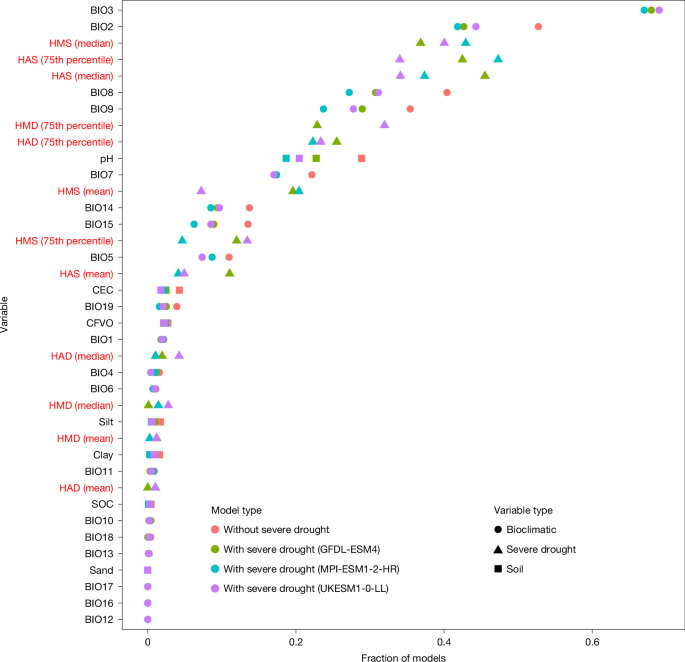
Extreme climatic events are increasing in frequency and intensity with climate change1. Their effects on species’ distributions and extinction risk remain poorly understood2,3,4,5,6,7,8,9. Most species distribution models rely on long-term mean climate, overlooking potentially important nonlinear effects of extremes. Here we integrate new spatial data on severe drought10, including compounding effects of warmer temperatures, with a comprehensive curated dataset of cactus occurrences (648,316 records) and species distribution models to assess how severe drought alters projected suitable climatic area for 993 species of Cactaceae, a highly threatened family11 that is commonly considered drought tolerant. In 91% of cases, models including severe drought were better supported than mean-climate models. Across emissions scenarios (Shared Socioeconomic Pathways (SSPs) SSP1-2.6 to SSP5-8.5) with 100-km dispersal, including severe drought increased the share of species losing suitable climatic area from 58–61% to 69–72%. The proportion of species projected to lose over a quarter of suitable area increased from 26–43% to 55–58%, and the proportion projected to lose over four-fifths increased from 1–15% to 25–35%. With severe drought, restricting dispersal from 100 to 0 km increased the share losing suitable area from 69–72% to 84–85% across SSPs. These declines reduced regional richness, with five bioregions potentially losing over 25% of species. These findings demonstrate that accounting for climatic extremes can alter assessments of biodiversity vulnerability under climate change. Integrating climatic extremes into ecological forecasting will be critical for assessing biodiversity loss and designing effective conservation strategies across taxa and ecosystems.
This is a preview of subscription content, access via your institution
Access Nature and 54 other Nature Portfolio journals
Get Nature+, our best-value online-access subscription
Prices may be subject to local taxes which are calculated during checkout
Given the data sharing agreement with iNaturalist and private contributors and the widespread risk of illegal collection in Cactaceae, occurrence data used for analyses are available only on request. Requests should be made through correspondence with the corresponding author and, depending on the taxonomic scope of the request, may require an agreement with one or more of the authors (data derived from BIEN or private contributors) or with iNaturalist directly, prohibiting further data sharing. Requests should include a complete list of data users and their affiliations, the purpose of the request, the taxonomic scope and a disclosure of any competing interests. Partially obscured iNaturalist data are available72. Average climatic data were retrieved from the CHELSA repository, version 2.1 (https://chelsa-climate.org/). SPEI drought data are available from the NASA Socioeconomic Data and Applications Center (SEDAC; https://www.ciesin.columbia.edu/data/globaldrought/). Soil layers were downloaded from the SoilGrids repository, version 2.0 (https://www.isric.org/explore/soilgrids). Expert distribution maps used to create Extended Data Fig. 7 were obtained from the IUCN Red List of Threatened Species and the IUCN SSC Cactus and Succulent Plants Specialist Group. Bioregion data were downloaded from a previous study52. All Figures and Extended Data Figures are directly reproducible from the Supplementary Information and code at Zenodo123.
All code is available at GitHub (https://github.com/mdpillet/DroughtForecasts) and archived at Zenodo123.
IPCC Climate Change 2023: Synthesis Report. Contribution of Working Groups I, II and III to the Sixth Assessment Report of the Intergovernmental Panel on Climate Change (IPCC, 2023).
Lynch, H. J. et al. How climate extremes—not means—define a species’ geographic range boundary via a demographic tipping point. Ecol. Monogr. 84,