// TOM'S HARDWARE US — HARDWARE & GADGET
Phison details SSD with a built-in NPU and 64GB of memory that supports AI frameworks on the drive
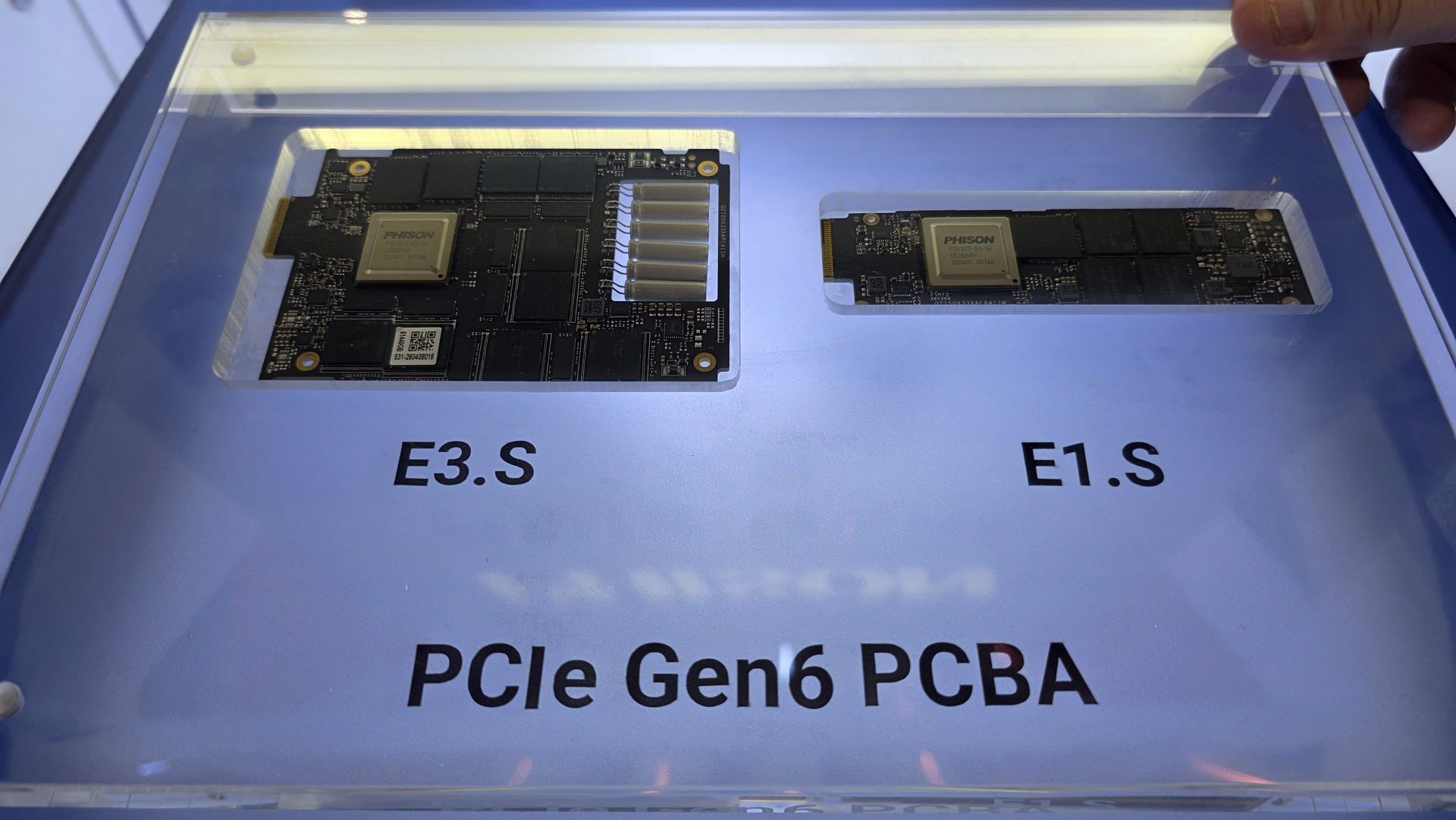
Neither design has a product name, a named controller or a sample date yet.
When you purchase through links on our site, we may earn an affiliate commission. Here’s how it works.
Phison detailed two new enterprise SSD designs at Supercomputer 2026 (SC26) that aim to answer two separate problems: one with a built-in NPU and 64GB of 130 GB/s memory that supports running PyTorch, vLLM, OpenVINO, and llama.cpp directly on the drive, and another that merges fast pSLC cache with large QLC capacity behind just one controller. The company notes that “many of the products and features mentioned are still in development” and will arrive once finalized.
The computational-storage design’s premise is that a server can offload more to the SSD, which runs AI code on the data where it already resides and sends back results, instead of whole datasets. The pSLC-QLC design, meanwhile, puts the cache inside each drive, which may reduce system complexity, as every drive bay contributes usable capacity and none goes to dedicated cache drives.
Phison says that the integrated NPU is expected to deliver “36,800 DMIPS of compute performance,” or Dhrystone Million Instructions Per Second, a typical synthetic benchmark. This is admittedly an old CPU integer benchmark from the 1980s, while NPUs tend to be rated in TOPS, but that figure was not given. For reference, the Topaz NPU add-in card Phison showed at Computex carried eight NPUs rated at up to 40 TOPS each. The DMIPS figure therefore likely refers to, instead, the CPU cores that work alongside it, which we would expect to be based on an Arm Cortex design, adequate for running an SSD of this class but no measure of its AI capability.
The memory and its bandwidth are more important for the expected workload, anyway, and while the company doesn’t state the type, LPDDR5X is a popular option and may be used with the Topaz NPU, according to one secondary report. If the drive is a PCIe 6.0 part comparable to Phison’s X3 controller, it could hit up to 28 GB/s to the host, which would put the memory above 4x that speed. For reference, 130 GB/s is a bit less than half of that of the DGX Spark’s hardware, designed for AI development.
Phison says developers can build on the drive “without specialized programming tools,” which, in this case, is a good thing. The drive does, of course, support multiple general-purpose inference servers and runtimes, but nothing was disclosed about how a host reaches the drive’s compute. The drives “scan and process data in parallel,” which indicates scalability, and return “relevant results” which Phison claims could mean 10 to 100 times less data transferred for applicable workloads. This may free up the host CPU for other tasks.
Phison’s idea to put compute on storage isn’t new. Samsung tried this with its SmartSSD — where an FPGA sat on the drive to process data without moving it — which was shown in 2018. Later, in 2022, the design was refined with AMD’s Xilinx Versal FPGA in its second generation, with Samsung claiming more than 50% lower processing time, up to 70% lower energy consumption, and up to 97% lower server CPU usage for scan-heavy database queries, compared to conventional SSDs. The drive has reportedly since disappeared from Samsung’s lineup, though the first-generation model was still sold under AMD’s Xilinx name as of last year.
ScaleFlux took a narrower route, with compression handled inside the SSD controller. The server doesn’t see this, so the drive looks like any other NVMe SSD, and no application has to change its behavior. The CEO claims it is the only company with computational storage in production at hyperscalers. This suggests that not making customers write new code for the drive is the secret to success, as SmartSSD needed that for its FPGA and for each workload. Phison’s selling point here is flexibility for the client to use code written for common AI frameworks.
Company CTO Sebastien Jean, writing in All About Circuits in 2025, argued t