// ARS TECHNICA — INTELLIGENZA ARTIFICIALE
Review: The Asus ProArt P16 offers a glimpse of a future powered by local AI
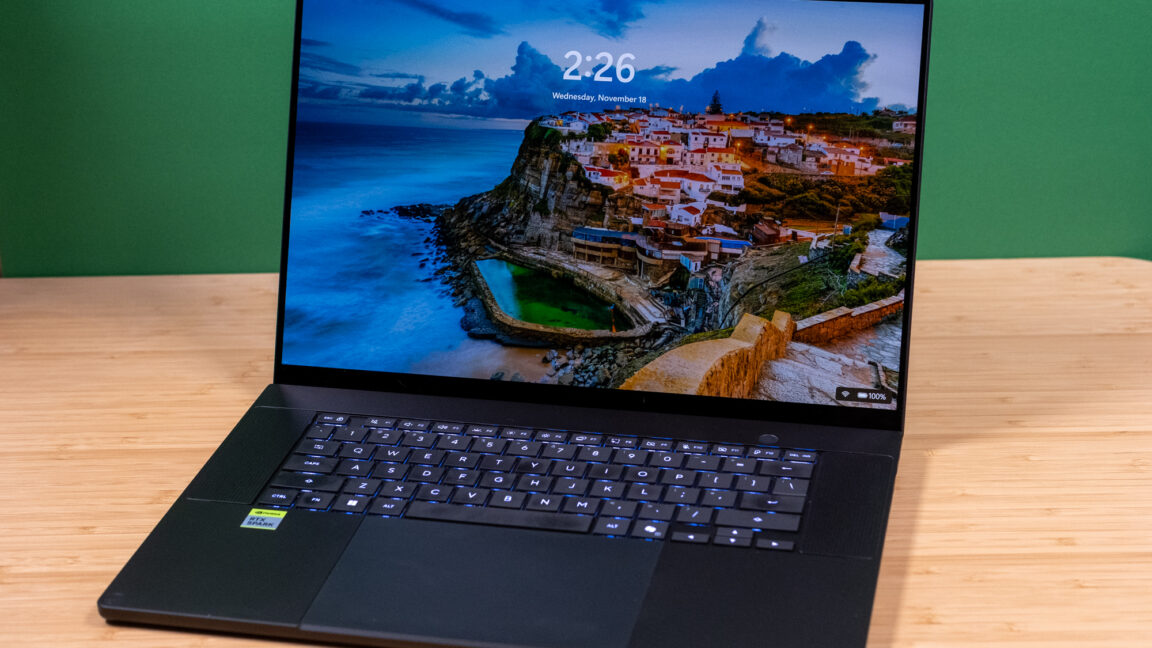
The new Asus ProArt laptop costs up to $7,000, but it can run a gaggle of local AI agents.
Buying a new computer in the last few years has meant wading through all manner of AI branding nonsense. Most of the AI pitches for laptops are little more than marketing hype, but the launch of Nvidia RTX Spark could bring a meaningful improvement in AI capabilities to the device you use every day. Asus has adopted Nvidia’s new chip in its latest ProArt lineup, offering a staggering amount of memory to run local AI models.
While it doesn’t have a traditional GPU, the Asus ProArt P16, with up to 128GB of memory, can also be your primary gaming and productivity machine, but this unified experience comes at a high price. If you want to run a small army of agents on your laptop, you’re looking at $7,000 for the top-end ProArt P16, and despite being more approachable on Windows, local AI still requires a lot of trial and error.
Before we dive into the AI agents, let’s talk about the ProArt P16 as a laptop. Nvidia’s pitch is that the RTX Spark can be your one true machine for AI, productivity, and gaming. And it doesn’t skimp on the specs.
Asus has released numerous ProArt laptops, but this one is notable for including the new Nvidia Spark RTX chip in its most powerful configuration. The Spark N1X has a 20-core Grace CPU, divided between 10 high-performance Arm Cortex-X925 cores and 10 power-efficient Arm Cortex-A725 cores. The performance cluster reaches boost speeds between 4.0 and 4.1 GHz, while the efficiency cores peak at 2.8 GHz. Memory caching on the processor totals 49MB, split between 24MB of shared L3 cache and 25MB of L2 cache.
Graphics and AI are the purview of the Nvidia GB20B Blackwell GPU. It packs 6,144 cores in this configuration across 48 streaming multiprocessors, backed by its own 24MB L2 cache. These 5th-generation Tensor Cores support the full suite of Nvidia technologies, including DLSS, Reflex, ACE, G-Sync, CUDA, and NVFP4. In all, you’re looking at up to 31 TFLOPS of FP32 graphical performance and about 1,000 TOPS of FP4 AI compute.
Asus will sell this device in two memory configurations (plus some lower-specced retailer-specific SKUs), but the one I’ve been testing (and the one that makes the most sense alongside the RTX Spark) has 128GB of LPDDR5x RAM. It supports up to 300GB/s of raw bandwidth, which is fast for shared system memory. However, using a dedicated GPU typically gets you higher throughput with a GDDR7 memory interface. Still, you get several times more memory than a gaming GPU in this machine.
This is essentially an Nvidia Spark DGX workstation with a screen and keyboard. It also runs Windows 11, which lowers the barrier to entry if you want local AI agents. While many local AI setups focus on 27-billion-parameter models that will fit on a video card, the Asus ProArt P16 can easily load models with 100-plus billion parameters, with enough left over for lighter background AI tasks.
Nvidia and Asus say the Spark’s AI compute and ample memory are enough power to run frontier-level AI models locally. That means you can get powerful AI compute without running through your allotment of expensive tokens or sending all your data to a server in the cloud. Ignoring the AI angle, the ProArt P16 has to be a good laptop before it makes sense for even the most AI-obsessed buyers to consider it. Luckily, it gets all the basic laptop things right.
It’s nice to see a wide array of ports on this machine. There are three USB-C ports with USB4 support, and they’re split between the left and right sides. That makes connecting devices and charging much easier. There’s also a legacy USB-A 3.2 Gen 2 port, full HDMI, a 3.5 mm jack, and an SD card reader.