// ARS TECHNICA — LINUX & OPEN SOURCE
Ladybird browser's first downloadable alpha is surprisingly capable
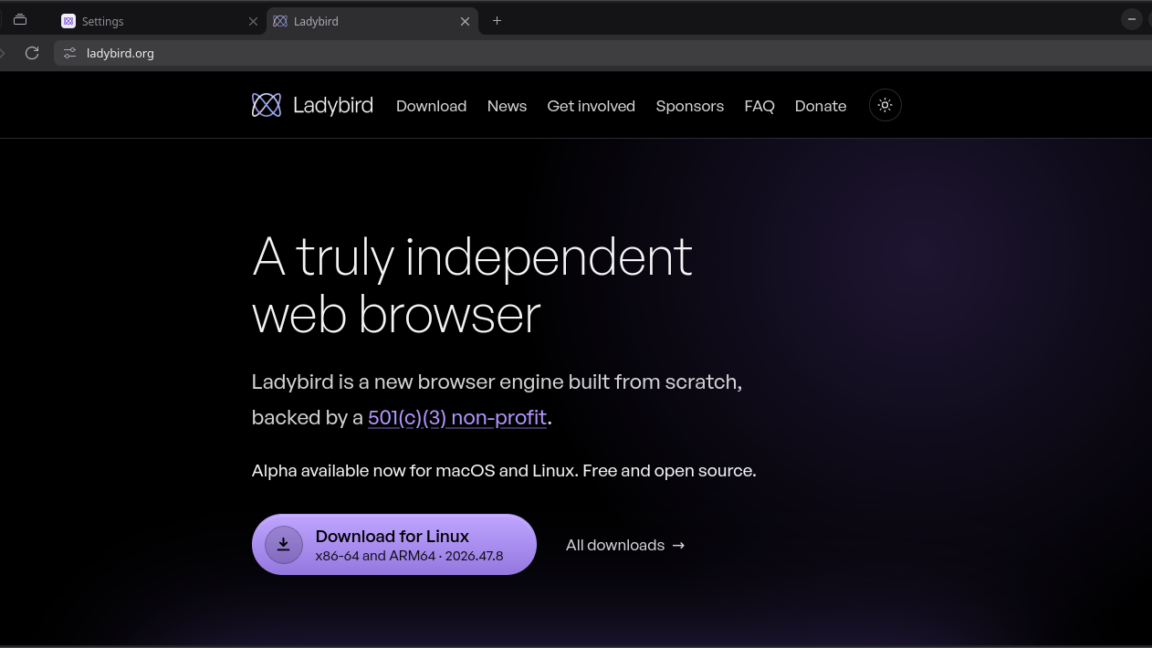
An independent browser engine arrives on Linux and macOS, and we’ve tried it.
After four years of work to build a browser engine from scratch, the Ladybird project released its first downloadable alpha on November 23, offering prebuilt versions for macOS and Linux. Previously, curious users had to compile the browser themselves from its source. Now it’s an installable package with automatic updating.
Ladybird is most notable for what it isn’t: another browser fork. Where Chrome, Edge, Brave, and Opera all run on Google’s Blink engine, and Firefox depends on Gecko, Ladybird’s rendering engine and its LibJS JavaScript engine were written from scratch. “The engine is our own, built from the ground up, and not a fork,” project lead Andreas Kling wrote in Monday’s announcement. “The browser around it is modest, but functional.”
Nearly the entire modern web currently runs on three browser engines. There’s WebKit (Safari), Gecko (Firefox), and the biggest of them all, Blink (Chromium). Those limited options mean that web developers often end up optimizing sites for Chromium specifically, since that’s where the majority of traffic is, and as a result, the whole web platform tends to follow suit toward whatever the dominant engine supports.
An independent implementation of web standards has value not just by providing additional competition in the market, but because it can’t help but reveal places where sites depend on Chromium behaviors rather than published specifications. The fact that Ladybird exists isn’t likely to shift the market tides any time soon, but every new browser engine increases the number of implementations that standards can be tested against, which can surface Chromium-specific assumptions and push the ecosystem toward the spec.
The Ladybird project was borne out of Kling’s SerenityOS project, an attempt to develop a new independent OS from scratch, before splitting off as a separate project. Kling formed the Ladybird Browser Initiative, a 501(c)(3) nonprofit funded by sponsorships and donations. The project’s site highlights that there are no sponsored search engine deals supporting the project like many other popular browsers, and sponsoring entities have no say in the project roadmap.
The Ladybird alpha is a rolling release channel that updates automatically, and the downloadable package is a huge step to getting the browser onto the PCs of everyday users. “Ladybird improves quickly, and until now you had to build it from source to see that,” Kling wrote. Though the browser began as C++, in keeping with the ethos of SerenityOS, the project has since started shifting toward Rust, starting with its JavaScript engine.
While it’s exciting to have a new engine option for browsing, the project leader notes that this is still a very early release. The browser build contains a built-in tool for reporting any websites that fail to render or crash the browser. Kling writes, “We want security nerds to hack it! A new browser gets hacked, over and over, and that’s part of the process, so we make no promises about security today.”
Microsoft users are still out in the cold on this one for now. The project says that future support for Windows is planned, but it’s macOS and Linux only for now.
I tested the Ladybird alpha version 2026.47.8 on my AceMagic W1 mini PC AMD Ryzen 7 8745HS with 16GB DDR5 and running Fedora Linux 44 with the new KDE Plasma 6.8.3, and the most surprising thing about the alpha build was how little it feels like alpha software.