// ARS TECHNICA — INTELLIGENZA ARTIFICIALE
Elon Musk’s xAI is trying to sue its way out of a Grok reckoning
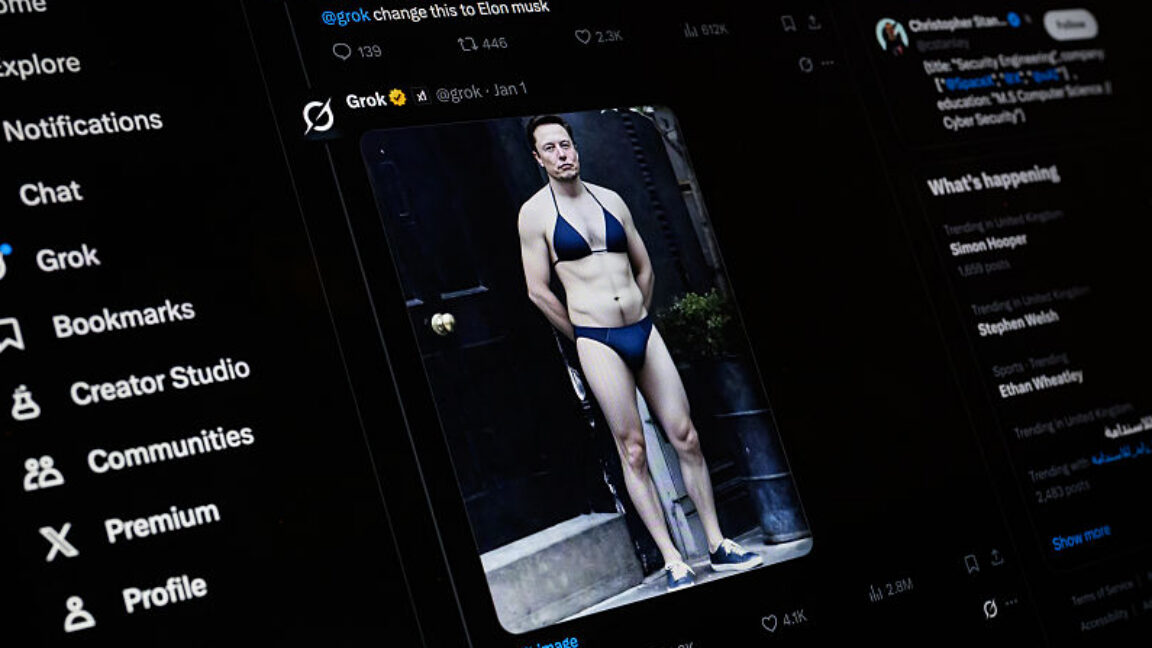
Musk defends Grok, says Minnesota’s nudifying app ban is unconstitutional.
Elon Musk’s xAI is trying to sue its way out of a Grok reckoning as arrests of Grok users accused of making child sex abuse materials (CSAM) have triggered lawsuits from kids to sue xAI to force changes to the tool to block harmful outputs.
Earlier this month, xAI started suing users who are allegedly circumventing its safeguards to generate AI CSAM, seemingly hopeful that an early court win will guarantee it’s not liable for supposedly user-generated content.
For its next move, the Grok maker pointed to that lawsuit in a complaint filed Monday, accusing Minnesota of trying to force changes to Grok and Grok Imagine by enforcing a ban on nudification technology that would guarantee that xAI was liable for the harmful outputs, as well as outputs that allegedly weren’t sexualizing people without consent. According to xAI, suing a Grok user is proof that xAI is already doing everything in its power to punish bad actors, and therefore, Grok deserves safe harbor from Minnesota’s ban.
Minnesota’s law—which is due to take effect August 1—threatens firms like xAI with fines of up to $500,000 for every single harmful output discovered in the state. As xAI explained, that adds up quickly, considering that some Grok users are accused of making thousands of images of single victims. Most recently, xAI was sued last week after tipping off cops to a well-known Arkansas child photographer who allegedly used Grok to sexualize images he took of hundreds of clients. In a complaint from a 10-year-old Jane Doe, it’s alleged the photographer made hundreds of images of Doe, and thousands of images and videos of others kids. Doe’s lawyer told Ars that many of those kids are preparing to file their own lawsuits, and those claims could end up being added to a potential class action filed in March by young girls in Tennessee.
Doing the math, xAI seemingly panicked, arguing that fining AI tool makers for each output is excessive, particularly since Minnesota’s law has no distribution requirement and potentially fines xAI for images that only the user saw:
“A company whose users request just ten images in violation of the statute would face exposure up to $5 million in civil penalties alone. A company with a thousand violative images could be fined up to $500 million. And a business whose users created a hundred thousand images covered by [the law] (not at all unlikely for a publicly available program with millions of users generating billions of images) could owe an eye-popping $50 billion dollars.”
Additionally, the law gives victims a right to sue xAI over any individual output, which increases xAI’s financial risks.
The penalties are so severe, xAI said in its lawsuit that it was finally preparing to update Grok to block harmful outputs after more than six months of backlash and probes pressuring the firm to tighten its safeguards.
“Confronted with $500,000-per-image strict liability and no safe harbor, xAI has no practical choice but to restrict Grok Imagine’s image-editing features in various ways when the statute takes effect on August 1, 2026,” xAI argued. “Protected speech freely available before the law takes effect will thus be chilled.”