// SPACE.COM — SPAZIO & SCIENZA
Astrophotographer captures a cosmic lagoon glowing 5,200 light-years from Earth (photo)
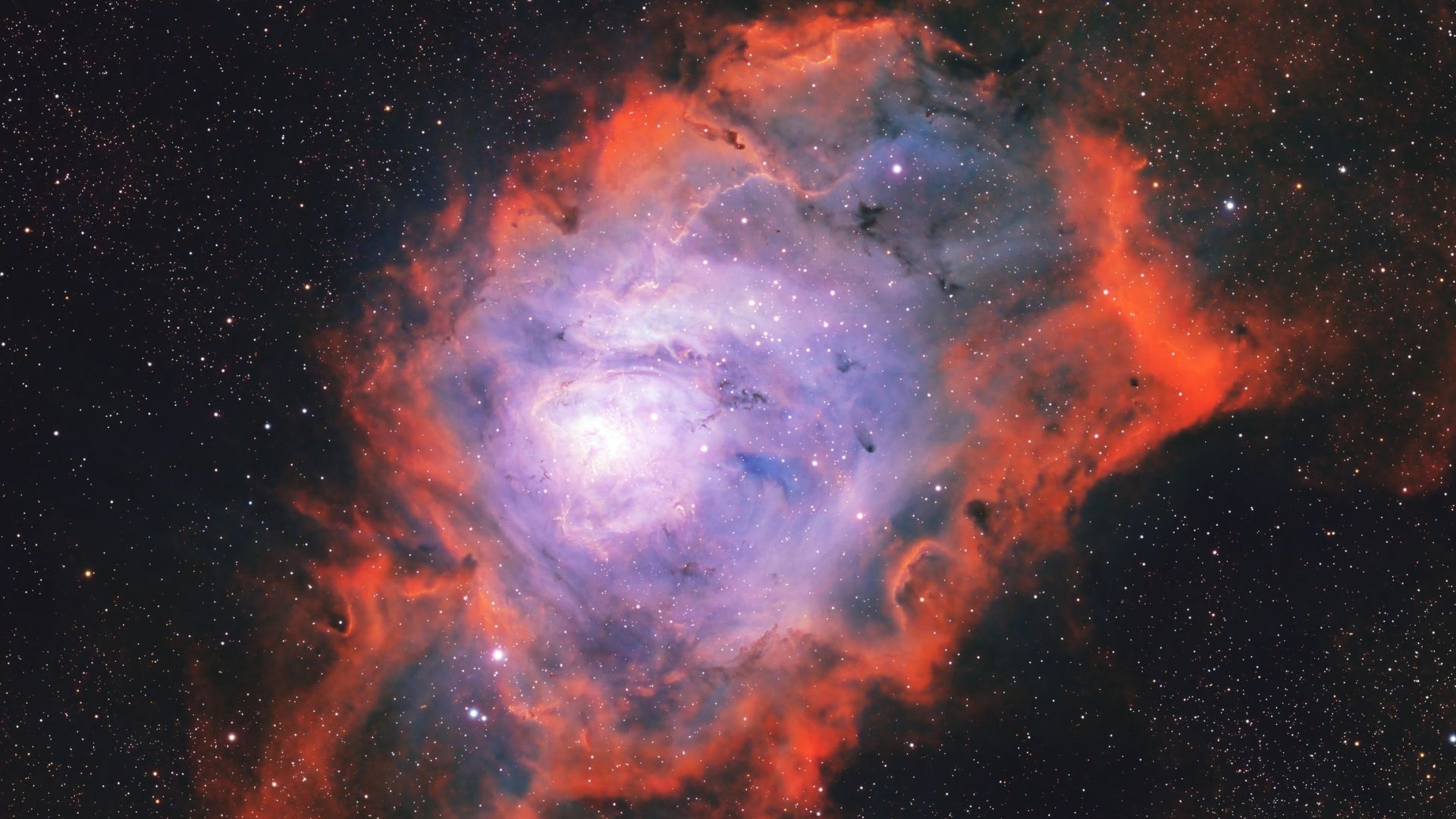
The Lagoon Nebula is best spotted in the months surrounding August in the Northern Hemisphere.
When you purchase through links on our site, we may earn an affiliate commission. Here’s how it works.
Amateur astrophotographer Noah Gyles has shared a stunningly detailed view of the Lagoon Nebula, captured as it glowed 5,200 light-years from Earth in the skies above Rockwell, Texas.
Gyles' colorful image reveals intricate detail in the vast interstellar cloud of dust and hydrogen gas, which has been ionized by the intense ultraviolet radiation from the population of hot, young stars embedded within the nebula, causing it to glow with its own light.
"I live in the Dallas-Fort Worth area, so I often drive about an hour outside the city to escape the light pollution," Gyles told Space.com in an email. "Since I wait for nights that are both moonless and cloudless, I don't get nearly as many chances to image as I'd like, but It never gets old seeing a camera reveal nebulae and galaxies in parts of the sky that look completely empty to the naked eye."
Gyles captured 60x5-minute exposures of the Lagoon Nebula on the nights of July 18 and 19 2025 using an Askar FRA500 telescope and ZWO astronomy camera, in conjunction with a set of narrowband astronomy filters. "This was one of the first targets I chose after upgrading my equipment," explained Gyles. "I had imaged it before, but I wanted to revisit it using narrowband filters, which isolate specific wavelengths of light emitted by nebulae."
Over six hours of light data was then carefully combined and edited to reveal the incredible complexity of the vast star-forming region. "The first five-minute exposure already showed more detail than I was expecting," said Gyles. "After stacking all 60 frames, I was amazed by the amount of structure and faint detail in the nebula."
The Lagoon Nebula is best viewed in the months surrounding August and is one of the few star-forming regions bright enough to be seen with the naked eye, appearing as a faint blur of light that becomes more prominent through a pair of binoculars or a small telescope, according to NASA.
One way to find the Lagoon Nebula is to identify the distinctive "Teapot" asterism in the constellation Sagittarius, which glistens low on the southern horizon to the left of the Milky Way around midnight in late spring and early summer.
We reckon the Celestron NexStar 8SE is the best motorized telescope out there as it's great for astrophotography, deep-space observing and it offers stunning detailed imagery. It is a little pricey but for what you get, it's good value. For a more detailed look, you can check out our Celestron NexStar 8SE review.