// SPACE.COM — SPAZIO & SCIENZA
'1 more step': NASA astronauts conduct 6.5-hour spacewalk to prep ISS for solar array upgrade
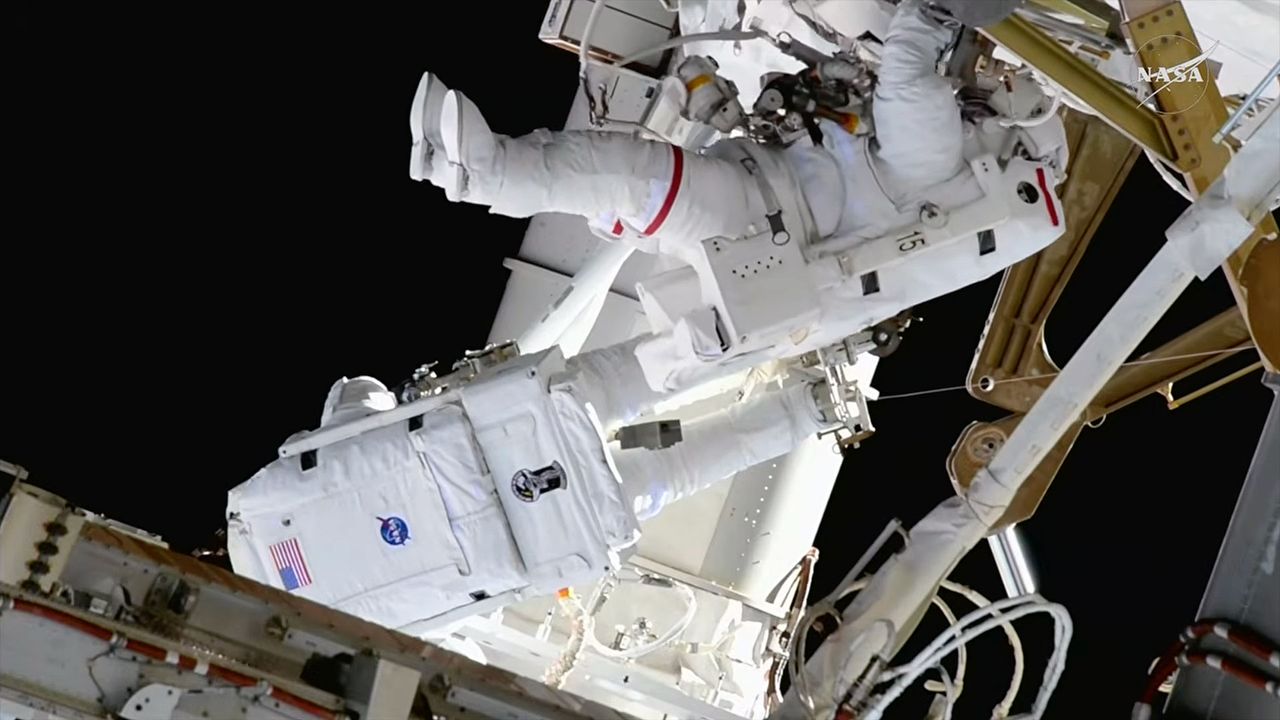
Jessica Meir and Anil Menon completed a 6.5-hour spacewalk outside the International Space Station on Thursday (Aug. 6).
When you purchase through links on our site, we may earn an affiliate commission. Here’s how it works.
Two NASA astronauts installed the seventh and final set of mounting hardware for new sets of solar arrays during a successful 6.5-hour spacewalk outside of the International Space Station.
Jessica Meir and Anil Menon on Thursday (Aug. 6), assembled the modification kit for one of the space station's eight power channels, which will allow for the future addition of a new ISS Rolll-Out Solar Array (iROSA). Since 2021, astronauts on prior spacewalks have deployed six of the iROSA assemblies, leaving now just two awaiting delivery to the station later this year.
Like building a giant erector set, Meir and Menon worked to assemble and bolt together the triangular brackets on the 3B power channel, located on the far right, or starboard (S6) segment of the station's backbone truss. Menon was positioned on an articulating portable foot restraint (APFR) atop a worksite interface (WIFEX), providing a stable angle to work from the truss.
Once the modification kit structure was built and secured to the 3B mast canister, the two spacewalkers routed cabling that will carry the electricity from the future iROSA into the 3B power channel and then covered the struts with multi-layer insulation to protect them from micrometeoroid strikes.
The iROSA wings sit forward of the legacy solar arrays, augmenting their electricity generation rather than replacing it. The station's eight original arrays began showing degraded power output as they exceeded their 15-year design life. When used in tandem with the new iROSA wings, the upgraded system will increase the station's electricity supply by 20% to 30%.
The other power channel currently without an iROSA deployed is 2A on the left, or port side, of the station.
"Anil, you can see the moon to the — well, I am not sure what way you're facing, but…," said Meir, taking a short break during the spacewalk to notice NASA's next destination for astronauts under its Artemis program.
"To my right. Yeah, I see it — thanks for the heads-up," said Menon. "I can see a future moon base there."