// NATURE NEWS — SPAZIO & SCIENZA
Temporal uncoupling of radial glia lineage progression in cortical organoids
Nature
(2026) Cite this article
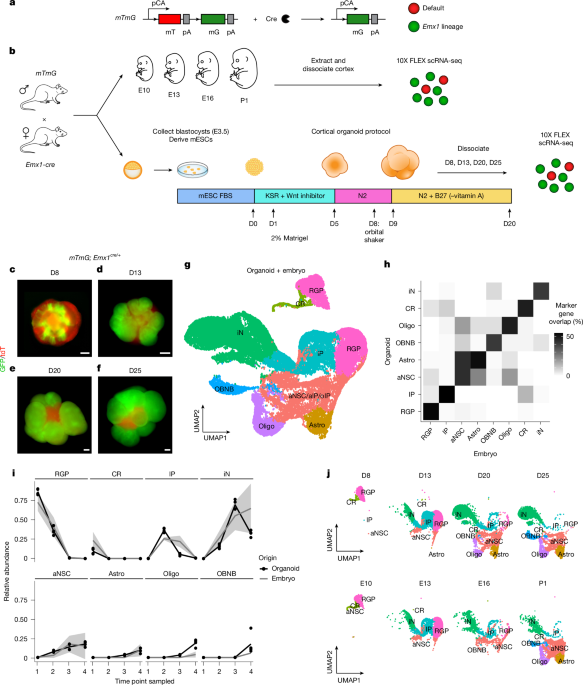
Radial glial progenitors (RGPs) produce all excitatory neurons in the developing cerebral cortex. Mosaic analysis with double markers (MADM)-based lineage tracing in vivo has revealed a quantitative framework of RGP lineage progression1. Here we established MADM technology2,3 in mouse embryonic stem cells to probe RGP lineage progression in a self-organizing cortical organoid system. We found that RGPs exhibit a high level of plasticity in proliferative potential in organoids rather than strict temporally stereotyped lineage progression as observed in vivo. RGPs in organoids showed increased lineage restriction, diminishing cell-type diversity in clones of cortical projection neurons, despite uniform single-cell transcriptional signatures of RGPs and a unitary lineage trajectory. Thus, critical non-cell-autonomous cues that are absent in self-organizing systems and/or the genuine stem cell niche are essential for faithful temporal control of RGP lineage progression and the generation of clonal cortical cell-type diversity.
The cerebral cortex is the seat of cognitive brain function and is composed of an enormous number and diversity of neurons and glial cells. Neural stem cells (NSCs), including RGP cells4,5 and their cognate cell lineages, generate and comprise all major neocortical projection neuron classes and macroglia6,7,8. Systematic clonal analysis at single-cell level in situ using MADM has provided an inaugural quantitative and temporally stereotyped framework of RGP lineage progression in mice in vivo1,9. Nascent RGPs initially undergo symmetric proliferative divisions, expanding their pool. Subsequent to a predictable number of proliferative divisions, and at a defined developmental stage, RGPs switch to asymmetric neurogenic division. RGPs in mouse generate projection neurons in units of 8–9 neurons, whereby birth order defines cell fate and laminar position. Following neurogenesis, a fraction of RGPs adopt gliogenic potential to produce astrocytes and oligodendrocytes1. RGP lineage progression proceeds in a strictly linear manner with sequential, largely non-overlapping and consecutive developmental timeframes. Faithful RGP proliferation behaviour and lineage progression are essential for the generation of a cerebral cortex of correct size and cell-type diversity10,11,12,13. The fundamental principles that instruct the transitions along RGP lineage and their chronological neurogenic or gliogenic potential are still unknown, although cell-intrinsic epigenetic and genetic cues seem to be critical. Indeed, cortical progenitors14,15,16 and mouse embryonic stem cells (mESCs) programmed to cortical lineage17 recapitulate limited RGP lineage motifs in isolated cell culture, and thus in the absence of an endogenous stem cell niche. Furthermore, recent advances in recreating major stages of embryonic development in vitro have revealed that self-organizing principles are sufficient for pluripotent embryonic stem cell lineage progression within all three germ layers18,19,20. Here, we focus specifically on cortical organoid systems in which self-organization appears to be the major driver for the concerted three-dimensional structural assembly of cortical structures, with all major cell types, from a set of embryonic NSCs, closely recapitulating developmental processes and cortical tissue-specific features21,22,23,24. However, whether and how self-organization can instruct committed multipotent progenitor cells and orchestrate temporally stereotyped NSC lineage progression in order to produce faithful quantitative and qualitative postmitotic cell fates and cell-type diversity is not known. Here we utilized lineage tracing with true single-cell resolution in situ and in silico to decipher the neurogenic RGP proliferation behaviour in an in vitro organoid system. We found that in self-organizing cortical organoids, RGP lineage progression contrasts in specific aspec