// NATURE NEWS — SPAZIO & SCIENZA
Degree-of-polarization modulation for high-dimensional optical computing
Nature
(2026) Cite this article
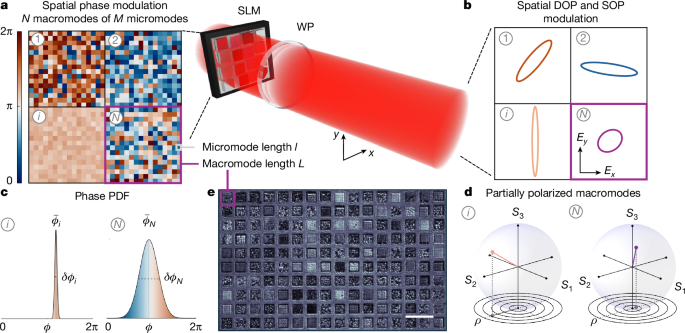
Spatial light modulation is a cornerstone of modern photonics. Crucial advances in photonic information processing1,2,3 rely on the spatial manipulation of the optical phase4,5,6,7,8,9,10,11,12 and state of polarization (SOP)13,14,15,16,17,18,19,20,21,22,23,24,25,26,27. The degree of polarization (DOP)28,29,30 is a fundamental property that can serve as an extra resource. However, no technology exists at present that can spatially modulate the DOP in a programmable manner31,32,33,34. Here we demonstrate spatial DOP modulation, thereby achieving control over a new degree of freedom of light. By engineering the polarization statistics at the micrometre scale with a phase-only spatial light modulator, we realize more than 1,024 spatial modes with fully programmable SOP and DOP. This structured light, sculpted in its polarization content to arbitrary shapes, enables direct encoding of information in a high-dimensional space. We encode colour images into a single-wavelength laser by using a one-to-one mapping between the red–green–blue space and the volume of the Poincaré sphere. Polarization colours expand the dimensionality of optical computing and encryption schemes, as demonstrated by (1) fully parallel photonic classification of colour images by a high-dimensional photonic neural network and (2) high-security multidimensional optical encryption. These approaches to optical processing of high-dimensional data highlight the opportunities enabled by DOP modulation in photonics, cryptography and computing.
Spatial modulation of the phase, amplitude and polarization lies at the core of every modern optical system, driving advances in emergent fields such as neuromorphic photonics1, structured-light communication2 and optical cryptography3. Programming the phase profile enables large-scale photonic implementations of deep neural networks (DNNs)4,5,6,7, reservoir computing8,9,10, Ising machines11 and generative models12. Manipulation of the SOP enhances this potential by offering a powerful multiplexing strategy and input–output operations inaccessible by scalar fields, unlocking polarization-based computing13,14,15 and encryption16,17,18,19. New methods for shaping20,21,22,23,24 and measuring25,26 the polarization across space are pivotal towards photonic technologies that make use of the high-dimensional nature of light27.
The DOP is a statistical degree of freedom that expands the space available for optical information encoding. Inherent in any optical system, the DOP quantifies the variation of the SOP in the temporal, spectral or spatial domain. Rephrasing the Feynman Lectures on Physics28, an electromagnetic wave is always polarized in nature and the DOP emerges from the measurement of an incoherent ensemble of waves. Light is partially polarized or unpolarized when the detection time is larger than the polarization fluctuation time29 or the detection area exceeds the coherence length30. DOP tuning has been realized with designed metasurfaces31 and by engineering the temporal32 or spatial33 integration performed by the detector. Although these methods are effective for a homogeneous laser beam, DOP modulation within the wavefront remains challenging, as it requires a photonic unit able to control locally SOP fluctuations. Static metasurfaces lack pixel-by-pixel programmability31, whereas attempts using time-switching liquid crystals have been hindered by their low operating frequency34. So far, no technique exists for arbitrarily modulating both the DOP and the SOP across space.
We address this gap by introducing a statistical approach to control the DOP. Using a spatial light modulator (SLM), we impose stochastic SOP variations at the micrometre scale and tailor their probability distribution function (PDF). The resulting spatial DOP modulator enables information encoding by means of the volume of the Poincaré sphere. The term ‘high dimensional’ refers to access