// NATURE NEWS — SPAZIO & SCIENZA
Neural basis of compositional control
Nature
(2026) Cite this article
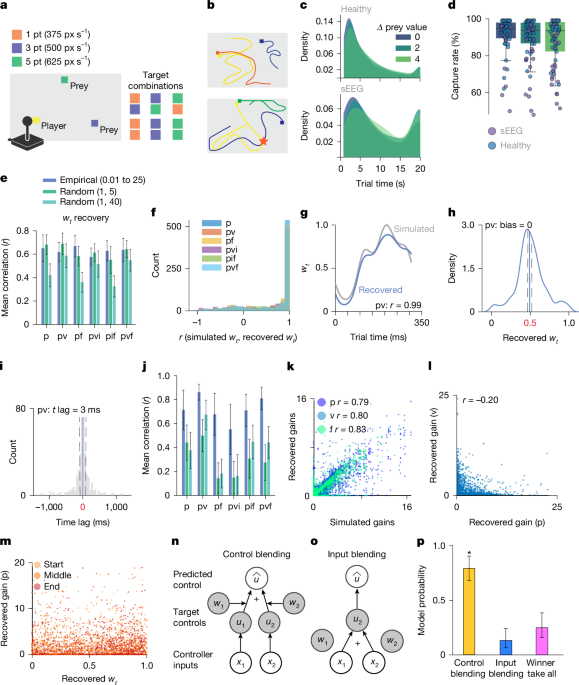
Naturalistic goal-directed behaviour often involves continuous actions directed at dynamically changing goals1,2,3. Just as microeconomics serves as a rigorous foundation for discrete choices, control theory can serve as a foundation for understanding choice in continuous ones3,4. In continuous contexts, behaviour is composed of blends of goals, and the closest analogue to choice is a strategic reweighting of goal-specific control policies5,6. Here, to understand the algorithmic and neural bases of continuous choice, we examined behaviour and brain activity in humans performing a continuous prey-pursuit task7. Using a newly developed control-theoretic decomposition of behaviour, we find that pursuit strategies are well described by a meta-controller dictating a mixture of lower-level controllers, each linked to specific pursuit goals. Neurons in the anterior cingulate cortex predict major changes in policy blends, whereas hippocampal neurons encode and update the latent policy state supporting early planning. Meanwhile, orbitofrontal cortex activity is consistent with an encoding of the current value structure of the task, rather than policy switching. Together these results are consistent with a tripartite functional division in which hippocampus serves as a state-estimating controller, anterior cingulate cortex serves as a meta-controller, and orbitofrontal cortex provides a value context signal.
This is a preview of subscription content, access via your institution
Access Nature and 54 other Nature Portfolio journals
Get Nature+, our best-value online-access subscription
Prices may be subject to local taxes which are calculated during checkout
All preprocessed data are available at https://doi.org/10.6084/m9.figshare.32572764.v3 (ref. 83).
All code is available at https://github.com/BCM-Neurosurgery/PreyPursuit.
Gordon, J. et al. The road towards understanding embodied decisions. Neurosci. Biobehav. Rev. 131, 722–736 (2021).
Article
PubMed
PubMed Central
Google Scholar