// NATURE NEWS — SPAZIO & SCIENZA
Numerous bow shocks in the outer Helix Nebula
Nature
volume 656, pages 334–337 (2026) Cite this article
Near the end of their lives, low-mass and intermediate-mass stars expel metal-enriched material in winds and outflows, ultimately producing planetary nebulae1,2. The ejected material is expected to fragment and mix into the interstellar medium (ISM), but this final assimilation step has been difficult to observe directly3,4. Here we report evidence for this process in the form of 22 bow shocks in the eastern outskirts of the Helix Nebula, detected in Hα emission with the partially completed MOTHRA telescope. Unlike the large-scale wind–ISM bow shocks commonly observed around evolved stars5,6,7, the shocks are compact and associated with individual clumps of gas. Going outward from the central star, the radius of curvature Rc decreases by a factor of roughly 102 over the radial range r = 0.4–1.4 pc. This is accompanied by a morphological transition from thin, well-defined bows to fuzzy, patchy structures. We interpret these changes as progressive stripping and fragmentation of asymptotic giant branch-shell remnants as they interact with the ISM. The slope of the observed Rc–r relation implies a loss of fragment coherence on a timescale of roughly 104 years, providing a rare direct constraint on the timescale for disruption and entrainment of fragmented stellar ejecta into the ISM8,9.
The Helix Nebula (NGC 7293) is one of the closest and brightest planetary nebulae, and therefore a benchmark for resolving how the late-stage ejecta of stars couple to their surroundings. Using the Gaia EDR3/DR3 astrometric solution for the central star (WD 2226-210), we adopt a distance of d = 198.6 (+1.6/−1.8) pc (ref. 10). Imaging of the Helix has shown it to be highly complex. Its bright main nebula comprises an inner disc and a surrounding outer torus, embedded within a larger structure whose upstream side is truncated, consistent with interaction between the expanding asymptotic giant branch (AGB) ejecta and the ambient interstellar medium (ISM)11,12,13. The ionized nebula is threaded by thousands of dense cometary knots and associated molecular material, indicating that much of the ejected material remains in a clumpy, only partially processed phase11,14. Deep imaging and spectroscopy have also revealed a bow-shock feature in the faint outer halo, in the direction of the nebula’s motion through the local ISM12,15. Together, these properties make the Helix uniquely suited to place direct constraints on how fragmented stellar ejecta are dispersed and mixed into the ISM: an essential step in the recycling of mass, dust and newly synthesized elements in galaxies4,9.
The Helix Nebula was observed in the light of Hα, [N ii] and [O iii] with the partially built Modular Optical Telephoto Hyperspectral Robotic Array (MOTHRA). MOTHRA is an array of high-end telephoto lenses equipped with tiltable ultra-narrow interference filters, located at the El Sauce Observatory in Chile. Its design evolved from the Dragonfly Spectral Line Mapper at New Mexico Skies Observatory16,17. When completed, MOTHRA will have 1,140 lenses distributed over 30 mounts, and be optically equivalent to a 4.8 m f/0.08 refractor. The data described here are equivalent to roughly 20 minutes of on-source exposure time with the completed array.
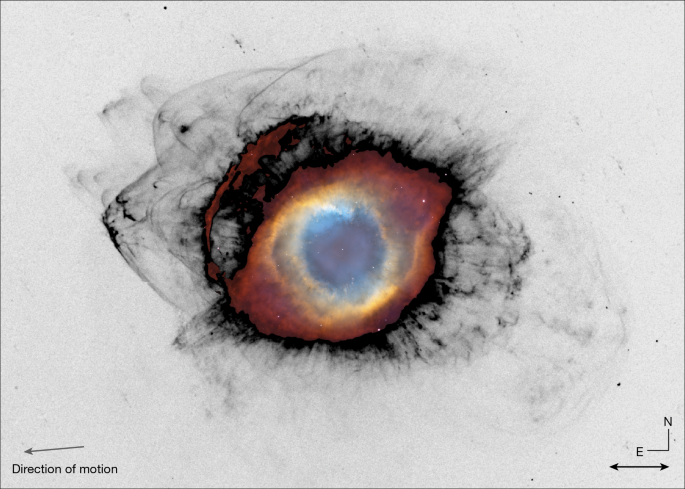
The MOTHRA Hα image of the Helix is shown in Fig. 1. It shows many features that have not been seen in ionized gas before, such as extensions of the plumes in the northwest and southeast11,13 and turbulent and complex low surface brightness Hα emission in the southwest13. The most striking feature in the Hα image is a forest of arcs and partial arcs on the eastern side of the nebula. We identify at least 22 arcs on the eastern side, labelled 1–22 in Fig. 3 in order of increasing distance from the central white dwarf. Although most of the features appear to be new discoveries, several can be seen in previous GALEX and Hα images. Besides the large and comple