// NATURE NEWS — SPAZIO & SCIENZA
Maternal influences on infant gut microbiome and health
Nature
(2026) Cite this article
The establishment of the infant gut microbiome is critical for later health1,2, yet how it is shaped by maternal and early-life factors remains unclear. Here we metagenomically sequenced 4,526 longitudinal faecal samples from 714 mother–infant pairs in the Dutch birth cohort Lifelines NEXT, spanning 12 weeks of pregnancy to 1 year postpartum. We integrated these data with 474 clinical and exposure variables, and with ultra-deep sequencing of breast milk and vaginal microbiomes. We observe that the maternal gut microbiome undergoes only subtle changes during pregnancy and postpartum, influenced by diet, infections and pre-pregnancy smoking. The maternal gut microbiome is a major reservoir for infant gut strains, with only occasional transmission from vaginal and breast milk microbiomes. Mother–infant gut strain sharing is time dependent, and higher maternal gut species abundance increases the likelihood of strain transmission. We find that the maternal gut microbiome is a predictor of infant eczema. Mode of delivery and feeding mode primarily shaped the infant gut microbiome and its functional profiles, with maternal exposures also having a role. Of 585 vaginally delivered infants, 155 were born at home, but home delivery was only moderately associated with infant gut microbiome composition, similar to other birth parameters such as duration of pushing and ruptured membranes. Overall, we highlight the central role of the mother and her microbiome in shaping the infant gut ecosystem and early health outcomes.
The establishment and evolution of the infant gut microbiome have a vital role in early immune development and later health outcomes1,2. During early life, the gut microbiome transitions from a largely uninhabited ecosystem to a complex microbial community, shaped by interactions between host and environmental factors3,4,5. Previous research has predominantly focused on individual determinants of infant gut microbiome development, including mode of delivery6,7,8,9,10, infant feeding practices3,11,12, antibiotic exposure9,10 maternal diet13,14,15 and pet exposure16.
However, an integrated understanding of how multiple pre-, peri- and postnatal exposures jointly shape infant gut microbiome development over time is lacking. In particular, relatively few studies17 have investigated the role of maternal exposures and the maternal gut microbiome during pregnancy in shaping the infant gut microbiome composition and health outcomes. Moreover, although mother-to-infant strain sharing is a hallmark of early microbial transmission6,18,19,20,21,22, the maternal sources and transmission routes identified through strain-resolved metagenomics remain incompletely understood.
Here, to address these gaps, we analysed 714 mother–infant pairs from the prospective, deeply phenotyped Dutch birth cohort Lifelines NEXT (LLNEXT)23. We characterized gut microbiome dynamics during pregnancy and infancy, examined associations with pre-pregnancy, delivery, dietary and health-related factors, and investigated maternal–infant microbial strain transmission across multiple maternal body sites.
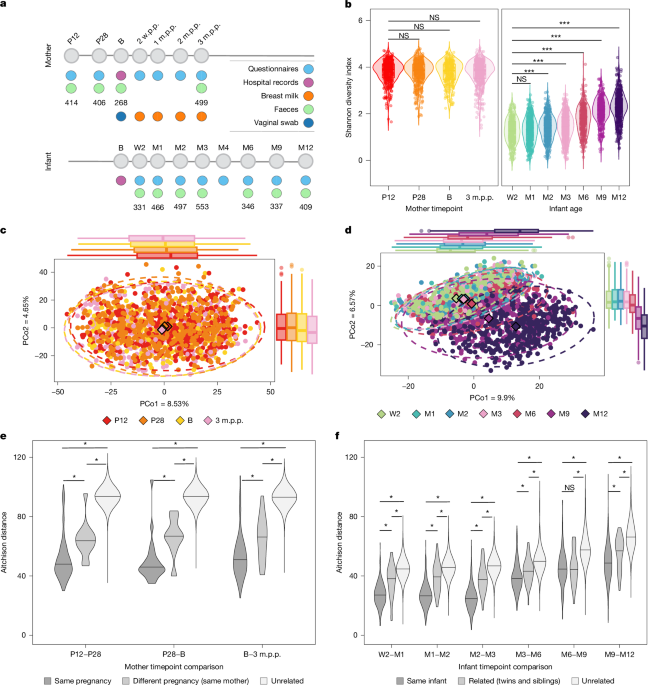
We longitudinally characterized the gut microbiomes of 714 mother–infant pairs included in the LLNEXT study, profiling 1,587 maternal faecal samples, 2,939 infant faecal samples and 474 clinical, dietary and exposure variables across ten timepoints (Fig. 1a and Supplementary Tables 1 and 2). For a subset of mothers, we also carried out ultra-deep sequencing (40 gigabases per sample) of the vaginal microbiome at delivery/birth (n = 82) and the breast milk microbiome at 1 month postpartum (n = 90). We also measured 24 human milk oligosaccharides (HMOs) in 586 breast-milk samples collected during the first 3 months postpartum (Fig. 1a). All cohort descriptive statistics are provided in Supplementary Tables 3–15. In brief, the average maternal age at delivery was 32 years (s.d. = 3.94; Supplementary Table