// NASA BREAKING NEWS — SPAZIO & SCIENZA
For West Virginia Engineer, Home Is Where the Heart Is… and NASA, Too
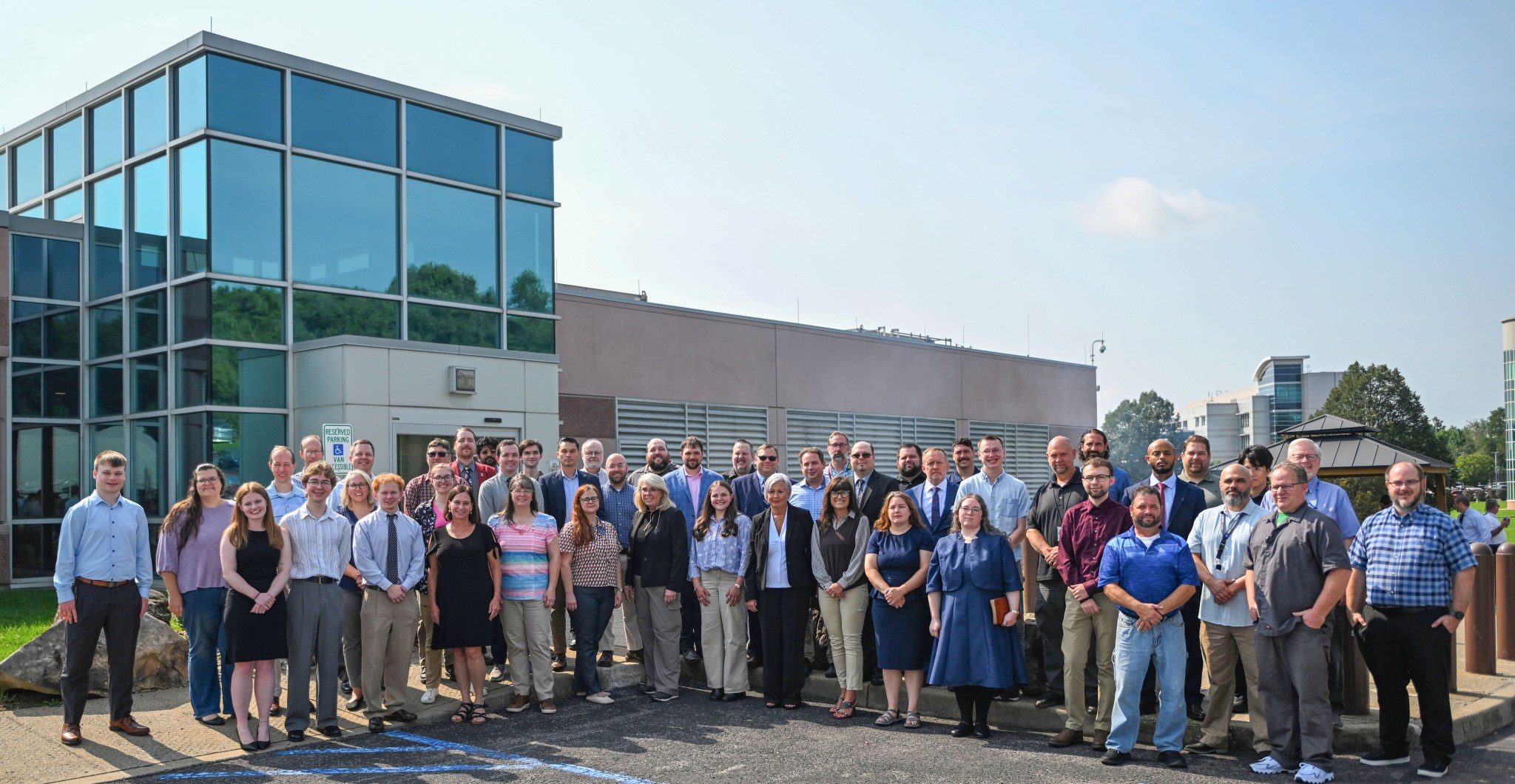
Growing up in Grafton, West Virginia, engrossed in Star Wars and all things science fiction, Fletcher Newell had an early interest in space exploration. That interest only grew when, in 2013, his fourth-grade class took a field trip to a nearby NASA facility he had not yet heard of – NASA’s Katherine Johnson Independent Verification & Validation Facility, located in nearby. Thirteen years later, Newell and 48 of his colleagues at the facility were sworn in as NASA civil servants during a ceremony on Aug. 10.
“I had always admired NASA from afar,” said Newell, who started working at IV&V as a systems engineer contractor in early 2025. “To my surprise, the agency was doing impactful work in my backyard.” During high school, he began cultivating programming skills that would lay the foundation for his future. A self-professed computer aficionado, Newell taught himself how to code. In algebra class, he discovered that his graphing calculator was programmable, leading him to create basic scripts. He quickly moved to popular software applications, learning how they were built in order to develop his own programs. Artificial intelligence was still on the brink of becoming mainstream, but he was already asking himself, “What are the more interesting things we can teach computers to do?” As a junior in 2019, the precocious programmer merged his talents with his passion for space after being accepted into IV&V’s high school internship program.Newell created a database for engineering methods, processing hundreds of documents to facilitate the work of his colleagues from a procedural aspect.
“Working as a high school intern really elevated my fascination for NASA,” he said. Following graduation in 2020, Newell headed west to Stanford University in Palo Alto, California, majoring in, naturally, computer science, with a focus on AI and machine learning when both were scaling rapidly across industries and in everyday usage. Instead of pursuing internships in the neighboring Silicon Valley – widely considered the global center for technological innovation – he returned to West Virginia for three consecutive summers, cutting his teeth at the Fairmont facility.
He began researching AI safety as engineers learned how to give spacecraft more onboard autonomy and have them learn on their own. Later, he was on a team responsible for assessing the safety of Terrain Relative Navigation, a vision-based guidance technology that could enable spacecraft to land on planetary surfaces without GPS. During his final internship, generative AI – which creates content based on user prompts – was becoming widespread, and he worked on teams exploring how to responsibly integrate it into mission assurance. Newell also performed research about autonomous space docking at Stanford’s Center for AI Safety, resulting in two publications. Following his undergraduate education, he remained at Stanford to earn a master’s in computer science. When it came time to enter the workforce, one organization was atop his list. A contractor opportunity opened up at IV&V, and he leapt at the chance. “I enjoyed the work at IV&V back in high school and college,” he said. “There’s nothing better than pursuing what aligns with your interests.” As a systems engineer, he has worked primarily on mission safety and security, identifying and resolving system defects and vulnerabilities for such spacecraft as Space Reactor-1 (SR-1) Freedom, Orion, Gateway, and the Human Landing System, all while helping guide NASA’s responsible adoption and development of AI systems. His colleagues took notice of their junior member’s contributions, resulting in Newell being named IV&V Engineer of the Year in 2025 less than a year into the job after identifying more than 70 issues in Gateway – and later SR-1 Freedom – with clear mission impact and, as noted in his award citation, developing a reputation for clearly articulating their implications. “During his internships and now as a full-time engineer, F