// HACKER NEWS — CYBERSECURITY
Forbidden City Cabbage
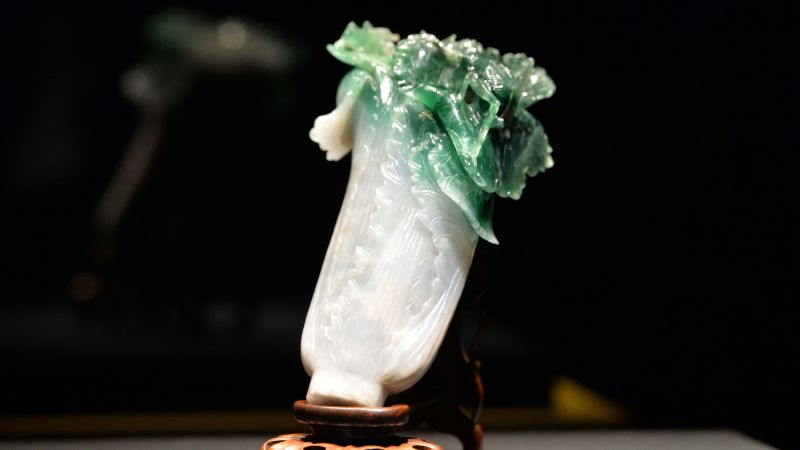
EDITOR’S NOTE: Curio is a CNN Style series spotlighting small objects and the big ideas behind them.
The Louvre’s “Mona Lisa,” the British Museum’s Rosetta Stone, MoMA’s “Starry Night” — major museums often have one must-see item that singlehandedly draws visitors from around the world.
For the National Palace Museum, in Taiwan’s capital Taipei, the star attraction is somewhat humbler: a cabbage.
Carved from a block of white and green jadeite, the remarkably realistic sculpture of a Chinese cabbage glistens as if freshly picked from a field, still wet with morning dew. A katydid and locust lurk in its verdant leaves, while the unknown sculptor used the material’s natural flaws to create the illusion of ribs running along its stems.
Resting gently on a wooden stand, the carving is just 7.4 inches tall. But it is so popular that it occupies its own exhibition hall. The museum even publicizes which dates the object will be away on “business trips” — in other words, when it is on loan or exhibited elsewhere — so visitors are not left disappointed.
The museum does not record how many of its approximately 2 million annual visitors come specifically to view the Jadeite Cabbage. But the long line of people waiting to snap photos suggests that many, if not most, of them do. “When you see it in pictures, it doesn’t seem that vivid, but when you see it here in true light, it’s really more attractive,” said Chloe Wang, a tourist from mainland China, during a trip to the museum.
The cabbage’s popularity often sees it dubbed a “national treasure” of Taiwan, although the sculpture is not officially designated as such. Its image is pasted across merchandise and turned into plush toys and replica models, in the museum store and beyond.
The Jadeite Cabbage, like most of the National Palace Museum’s collection, is an imperial relic once housed at the Forbidden City in Beijing before being relocated to Taiwan during the Chinese Civil War. It is, by no means, the only one: Beijing’s Palace Museum and the Tianjin Museum, also in mainland China, both have cabbages carved from jade. In fact, the Taiwan museum itself even has two other examples.
So why did this one, also known as “Jadeite Cabbage with Insects,” achieve global fame?
Hsu Ya-hwei, an art history professor at National Taiwan University, said the jade’s shimmering colors and the sculptor’s technique help the piece stand out. “The craftsmanship, combined with this particular piece of the material, produced a good result,” she said.