// SPACE.COM — SPAZIO & SCIENZA
Scientists find 3 supermassive black holes on the verge of collision inside a distant galaxy
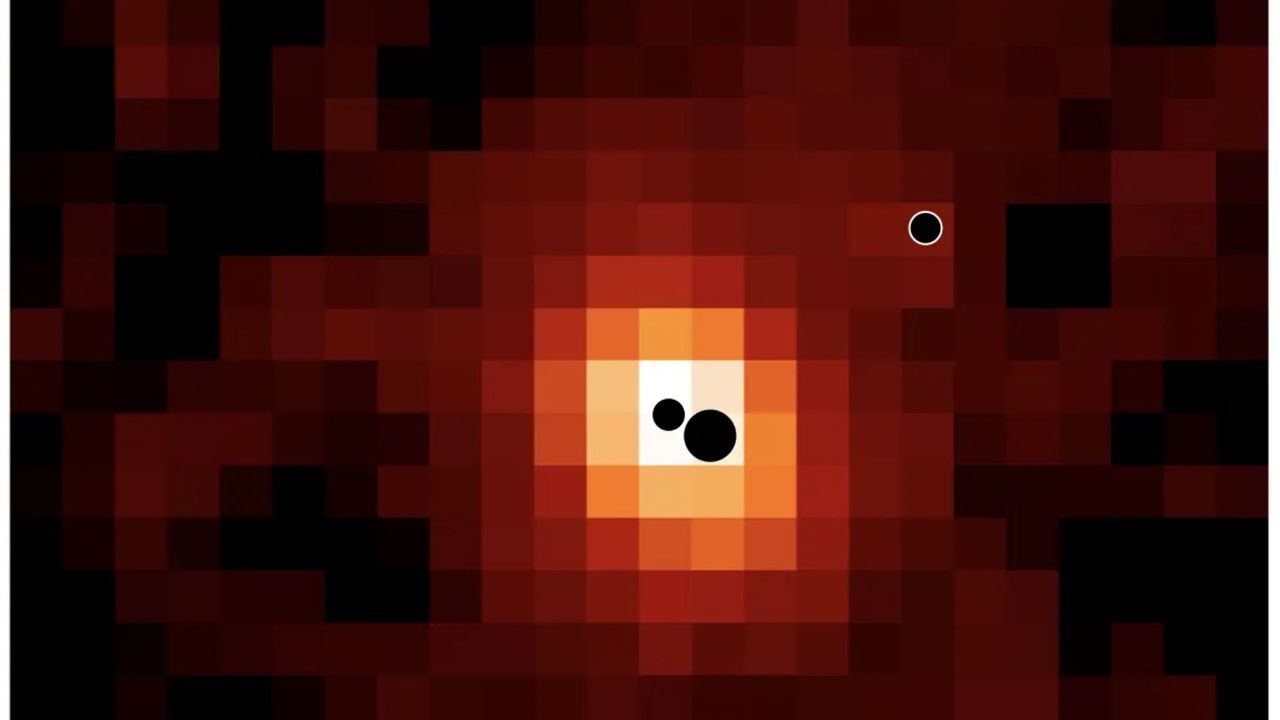
A greedy galaxy that existed less than 1.3 billion years after the Big Bang is hoarding supermassive black holes.
When you purchase through links on our site, we may earn an affiliate commission. Here’s how it works.
A trio of heavyweight black holes are entangled in a dance of death that will quite possibly see them gradually all merge to form an even greater behemoth.
Scientists have discovered the black holes in a galaxy that is so far away its light has taken 12.5 billion years to reach us, meaning we see it as it was less than 1.3 billion years after the Big Bang. And it's offering strong supporting evidence that one of the ways black holes grew so massive so quickly in the early universe was through mergers.
"This is the first evidence of three active black holes in a single galaxy in the distant universe," Hannah Übler, an astronomer at the Max Planck Institute for Extraterrestrial Physics in Germany who led the study, said in a statement. "It suggests that processes in the early universe were efficient at bringing massive black holes together, setting the stage for the massive black-hole mergers we expect to detect with future gravitational-wave observatories."
The galaxy that plays host to the black holes is catalogued as J0148-4214 and is so far away (their redshift is 5.0167) that the James Webb Space Telescope (JWST), which made the discovery, could not see the black holes directly. Instead, the Integrated Field Spectroscopy unit on the JWST's Near Infrared Spectrometer (NIRSpec) measured the motion of hydrogen gas swirling around at high velocity in the accretion disks encircling each black hole.
"The JWST data allowed us not only to identify the three black holes, but also to estimate their masses, accretion rates and the stellar mass of the galaxy," Giovanni Mazzolari of the Max Planck Institute for Extraterrestrial Physics said in the statement. "We find a total stellar mass of about 1.3 billion suns, and the black holes represent a significant fraction of that."
Two of the black holes reside at the center of J0148-4214, separated by 620 light-years. One of these black holes has a huge mass of 80 million times the mass of our sun, while its companion is a relative pipsqueak at 600,000 solar masses. Yet despite its diminutive stature, the smaller black hole is growing at a tremendous rate by accreting gas faster than the Eddington limit. This is the theoretical maximum rate at which material can fall towards a black hole; if the rate is any higher then the accretion disk around the black hole becomes so dense and hot that radiation from the disk blows material back out again, stifling the black hole's feeding frenzy. This means the smaller black hole will only be able to keep growing at this rate for a short time before negative feedback calls a halt.
The third black hole is 5,500 light-years out from the center of J0148-4214 and has a mass two million times greater than the mass of our sun. This is about half the mass of the supermassive black hole at the center of our Milky Way galaxy, called Sagittarius A*. It's thought that this third black hole, and quite possibly the second one too, found their way into J0148-4214 via mergers between galaxies.
"These results are extremely exciting," said Roberto Maiolini of the University of Cambridge, who was a participant in the findings. "They suggest that black-hole merging may be an additional, fast route for their rapid growth in the early universe."