// NATURE NEWS — SPAZIO & SCIENZA
Asymmetric prefrontal representations for leader–follower dynamics
Nature
(2026) Cite this article
Across species, cooperative behaviour is often organized by distinct social roles such as leaders and followers1, yet the neural mechanisms that support these emergent role dynamics remain unclear. Here we introduce a mouse paradigm that captures leader–follower dynamics during cooperation. In this paradigm, stable social roles emerge through reciprocal interaction and predict learning speed. Disrupting the activity of the medial prefrontal cortex (mPFC), particularly in followers, impairs cooperation and induces complementary shifts in how animals weigh self- and partner-related cues during decision-making. Calcium imaging reveals that the mPFC represents leader–follower dynamics and computes an egocentric social value map of the partner’s position in a role-dependent manner. By integrating these empirical findings with a multi-agent inverse reinforcement learning framework, we identify latent value functions that guide cooperative decisions and are decodable from mPFC activity. These findings identify prefrontal representations of leader–follower dynamics and partner information, revealing how social roles structure asymmetric yet reciprocal influence over joint decisions.
Cooperation is widespread across social species2,3 and is foundational to human society4. Among the most common strategies for organizing cooperative behaviour are leadership and followership, roles that allow individuals to exert asymmetric influence over one another in pursuit of shared goals1,5,6,7,8,9,10,11. However, a robust and ethologically grounded paradigm for studying leader–follower dynamics is still lacking in mice, posing a critical barrier to harnessing modern neuroscience tools in this model organism12,13. Consequently, the neural mechanisms by which social roles are instantiated as distinct behavioural strategies and shape coordinated decision-making remain largely unclear14.
In contrast to discrete turn-based games15,16,17, naturalistic social interactions unfold continuously, requiring moment-to-moment coordination18. Moreover, an animal’s underlying goals and strategies are often unobservable, particularly during reciprocal interactions between multiple individuals. Although inverse reinforcement learning (IRL) provides a principled framework for inferring internal models from observed behaviour19,20, extending IRL to multi-agent biological systems introduces substantial complexity. These challenges have limited our understanding of how neural circuits construct role-specific models of a social partner and implement the differential influence that characterizes leader–follower dynamics.
To address these questions, we developed a cooperative foraging paradigm in mice and a multi-agent IRL (MAIRL) framework. We find that stable leader and follower roles emerge spontaneously through reciprocal interaction, and that the mPFC encodes not only leading versus following but also a role-specific, egocentric social value map of the partner that mirrors MAIRL-inferred goals. These findings reveal how leader–follower dynamics are instantiated as asymmetric prefrontal representations, linking role-based decision-making to egocentric partner encoding at the cellular resolution.
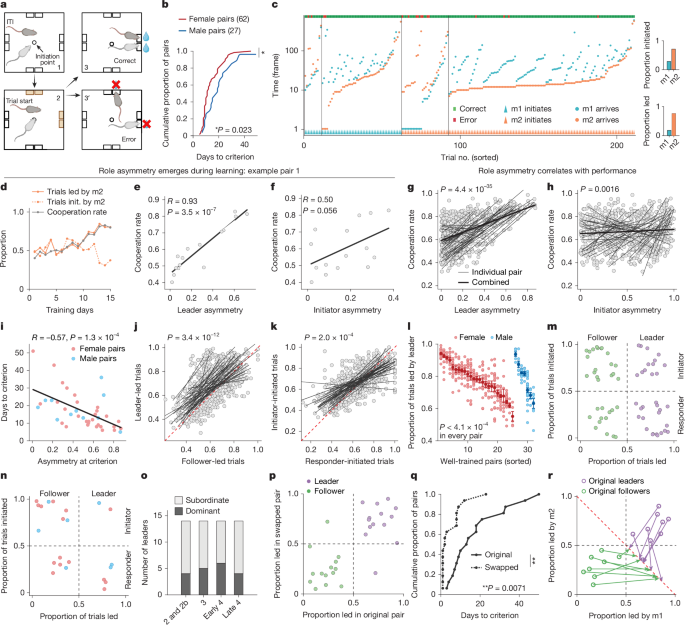
In the cooperative foraging paradigm, pairs of water-restricted, same-sex cage mates freely interact in a square arena to obtain water rewards (Fig. 1a and Supplementary Video 1). Each arena wall features a reward zone with two ports, enabling simultaneous access. A trial begins when either mouse crosses a central initiation point, triggering random activation of two of four reward zones indicated by light-emitting diode (LED) lights. To earn a reward, both mice must navigate to the same active zone and make concurrent nose pokes into the two ports. Trials end in error if mice poke concurrently in different active zones (mismatch error) or either mouse pokes in an inactive zone (unrewarded error), resulting in no