// NATURE NEWS — SPAZIO & SCIENZA
Multiyear tropical warm pool warming drives slowdown in Antarctic mass loss
Nature
(2026) Cite this article
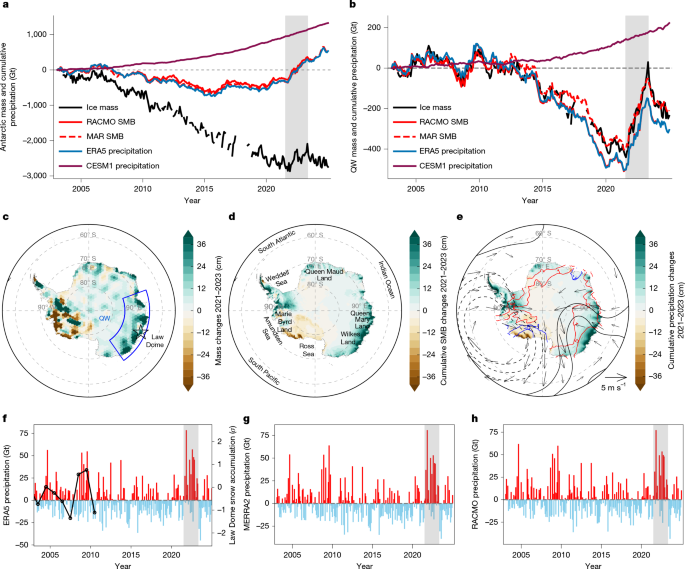
Antarctic mass loss has been a major contributor to global sea-level rise for most of the last few decades, mainly driven by West Antarctica1. During 2021–2023, however, a sharp increase in surface mass balance over Queen Mary Land and Wilkes Land in East Antarctica offset West Antarctic loss and slowed the rate of total ice mass loss2,3. Although this slowdown is consistent with the expected long-term precipitation response to global warming through poleward-shifted storm tracks and Antarctic moistening4, our results point to a different mechanism. Here we show that the recent ice mass gain was linked to a recurrent atmospheric teleconnection driven by sea surface temperature anomalies in the tropical warm pool, which experienced unusually persistent warming from 2021 to 2023 relative to the previous two decades. On the basis of observations and model experiments, we find that tropical warm pool warming excites a poleward-propagating Rossby-wave train that induces a high-pressure anomaly over East Antarctica, enhancing Queen Mary Land and Wilkes Land precipitation and driving the observed mass gain, with moisture primarily sourced from the mid-latitude Indian Ocean. Similar multiyear warming in the tropical warm pool recurs about once per decade in observations and historical simulations, and its influence on precipitation is distinct from the effects of global warming. Therefore, the recent Antarctic Ice Sheet mass gain is probably temporary and does not yet reflect a sustained, global-warming-driven moistening of Antarctica.
Future global sea-level rise is contingent on the stability of the Antarctic Ice Sheet (AIS), which remains the largest source of uncertainty in long-term sea-level projections1,5. Over the past three decades, the AIS has shown pronounced regional contrasts in mass changes. West Antarctica has experienced sustained mass loss, estimated at 82 ± 9 Gt yr−1 during 1992–2020 (ref. 6), driven primarily by oceanic processes, specifically ocean-forced grounding-line retreat and the resulting enhancement of dynamic ice discharge over the Amundsen Sea sector7,8. By contrast, the current mass balance of the East AIS (EAIS), which contains nearly 80% of Earth’s land ice, is more sensitive to precipitation-driven variability9,10,11,12, so snowfall fluctuations can offset or even reverse mass loss6,11. Consequently, the East AIS was quasi-balanced over the same period (3 ± 15 Gt yr−1), although individual estimates diverge from zero beyond their uncertainties6. Regional exceptions to this rough equilibrium occur in Wilkes Land and eastern Queen Mary Land, particularly at the Totten and Denman Glaciers13,14,15,16. In these regions, similar to West Antarctica, enhanced intrusions of modified circumpolar deep water onto the continental shelf have driven ice-shelf basal melt and acceleration of outlet glacier ice flow since the late 20th century15,17.
Coastal precipitation around East Antarctica (EA) is primarily regulated by large-scale atmospheric circulation variability9,18,19, with episodic, high-intensity synoptic storms and atmospheric rivers (ARs)20,21. As a result, surface mass balance (SMB) in EA shows substantial natural variability across a wide range of timescales22. During 2021–2023, EA experienced a large mass gain, leading to a slowdown in integrated Antarctic-wide mass loss over the past two decades, despite continuing mass loss in West Antarctica. Previous studies have linked the EA mass-gain event to several factors, including enhanced precipitation associated with clustered AR intrusions23, the prolonged triple-dip La Niña that displaced Southern Hemisphere storm tracks poleward24, cyclonic circulation anomalies2 and reduced sea ice extent3.
Under global warming, both the subtropical and mid-latitude jets show a pronounced southward shift, as supported by CMIP6 model experiments4. The associated synoptic storm tracks and AR activity also