// NATURE NEWS — SPAZIO & SCIENZA
Discovery of a star sensitive to the spin of Sagittarius A*
Nature
(2026) Cite this article
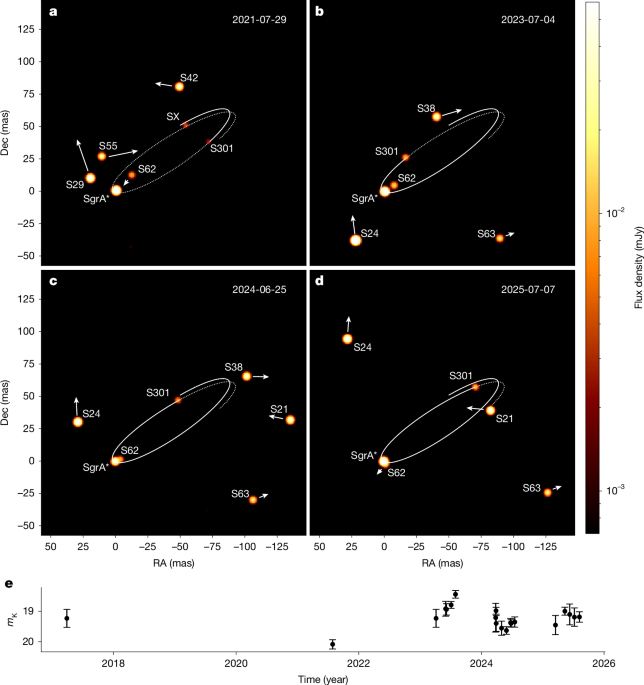
Residing in the centre of the Milky Way, Sagittarius A* (Sgr A*) is the closest massive black hole1 (MBH). Its vicinity has allowed measuring individual stellar orbits around it2,3,4. The stars act as test particles and probe the gravitational potential around the 4.3 × 10⁶M⊙ MBH. These observations have determined the central mass to sub-per-cent precision5, and the mildly relativistic motions of stars have given access to the dominant relativistic corrections, the gravitational redshift6,7, the transverse Doppler effect and the prograde precession imposed by the Schwarzschild metric nature of the potential8. These effects are of order β2 = (v/c)2 (for velocity v and speed of light c). The Kerr metric for a rotating black hole leads to corrections of order β3. Here, we report the discovery of a faint main-sequence star (mK = 19.3), S301, on an 8.7-year orbit and with small enough a pericentre distance, such that the peak velocity of the star reaches 25,000 km s−1. Within the measurement abilities of current near-infrared interferometry and future spectroscopy on an extremely large telescope, the motion of S301 is directly sensitive to the spin of Sgr A*. The high eccentricity of S301 suggests that it is the captured component of a binary that was torn apart by the Hills mechanism.
Black holes in general relativity have just two additional degrees of freedom beyond mass: spin and charge. Astrophysically relevant is the spin. As all objects in the Universe rotate, we expect the same for black holes, in particular, because the angular momentum of material creating a black hole is conserved. As the effects of the spin on space–time fall off with distance r to the black hole at a rate of r−3, it is actually hard to measure a spin. The existence of jets in active galactic nuclei requires that the massive black holes (MBHs) located in the central engines rotate9. Spin estimates have been obtained from X-ray reflection spectra, in which the iron Kα line shape is a probe of the spin, albeit the impact of spin is small10. For accreting stellar-mass black holes, spins can be estimated from accretion theory11, and thus are not assumption-free. The cleanest signatures are probably those of gravitational wave mergers, in which the spins of the initial objects are among the fit parameters to the pre-mergers wave forms12, and the spin of the resulting black hole can be inferred from its ringdown signature13. The space experiment Gravity Probe B detected the spin-induced precession because of Earth twisting space–time with 5σ significance14, testing the far-field and slow-motion approximation around a massive body, which equals the approximation of the Kerr metric in the same limit15. Overall, there are only few observational constraints on the spin parameter of the Kerr metric.
Sagittarius A* (Sgr A*), the closest MBH in the Galactic Center (GC) at a distance of 8.3 kpc offers a direct, dynamical way to measure its spin. The observation of stellar orbits has made Sgr A* one of the best cases for the existence of black holes in general. A few dozen stars revolve on (nearly) Keplerian orbits, with an almost relaxed eccentricity distribution and randomly oriented orbits. Most valuable are the stars that come closest to Sgr A*, as they probe deepest into the gravitational potential. In particular, the star S2 on a 16-year orbit2 has been in focus, because of its comparably easily accessible orbit. The motion of S2 is notably affected by relativistic effects: During its 2018 pericentre passage, the gravitational redshift of Sgr A* led to an additional change of measured atomic line positions of about 200 km s−1 (refs. 6,7). By 2020, the astrometric data of the star showed that the orbit had precessed in 2018 by around 12′, fully consistent with a motion in the Schwarzschild metric8. Key for these discoveries was the advent of near-infrared interferometry with the GRAVITY instrument a