// NATURE NEWS — SPAZIO & SCIENZA
Daily briefing: How 3D printers are changing lab work
Search author on:
PubMed
Google Scholar
Hello Nature readers, would you like to get this Briefing in your inbox free every day? Sign up here.
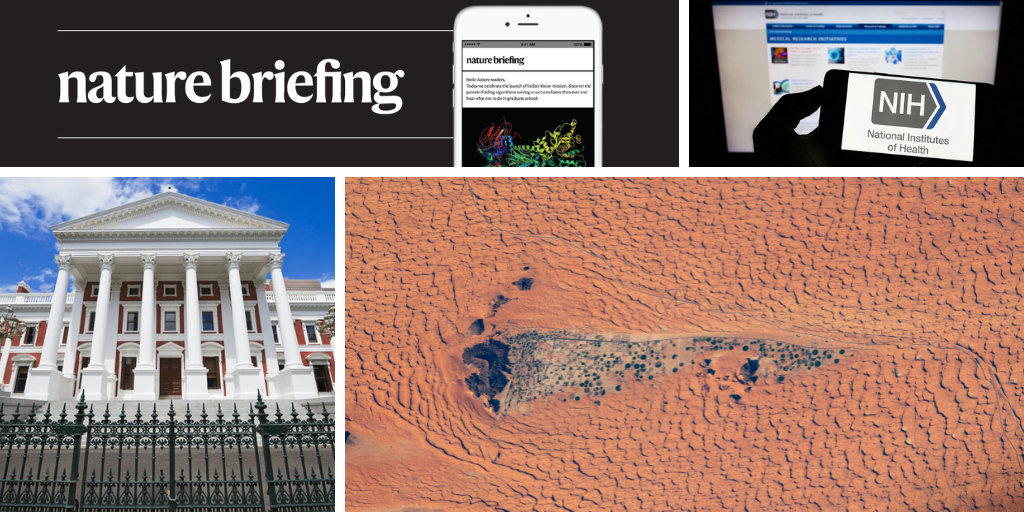
Tools found at an archaeological site near Jubbah, Saudi Arabia (shown here) more closely resemble those crafted by Neanderthals than those made by Homo sapiens, researchers say. (NASA/digitaleye via Alamy)
An analysis of stone tools thought to have been crafted by Neanderthals suggests that the ancient humans might have roamed as far south as the Arabian Peninsula around 55,000 years ago. The artifacts come from a site beside an ancient lake in what is now Saudi Arabia’s Nefud Desert. The characteristics of the tools, and efforts to date the sand of the site, suggest that Neanderthals might have lived there just as the area was shifting from desert to a wetter environment — which could have drawn animals, and the humans who hunted them, further south.
New legislation set to go before South Africa’s parliament would require natural scientists in the country to register with a government-backed regulatory agency, or face up to a year in prison. The proposed law would regard natural scientists similar to engineers and healthcare professionals, who need to register with their respective regulatory bodies. Natural scientists who spoke to Nature, many of whom were unaware of the legislation, are divided. Some say it could reduce the problem of fraudulent consultant scientists in the country. Others say membership is too expensive, and think it grants the regulatory agency unwarranted power.
The US National Institutes of Health (NIH) has proposed an overhaul of how it decides which research projects to fund, and how it reports the outcome of those deliberations. Under the new plan, the agency would report whether project proposals were ranked in one of three broad categories — a top, middle and bottom — based on their merit, rather than the precise numerical scores assigned to project proposals by peer reviewers that researchers have historically received. The scheme is part of a shift away from relying on peer review to award funds based on agency priorities, the agency says.
Robotic exoskeletons that support movement have historically only been used as rehabilitative aids. But today, both researchers and companies have their sights on developing exoskeletons that could augment people’s movements outside of a clinical setting, for example to help elderly people walk. Several teams are developing robotic aids that are light, cheap and easy-to-fit enough for the range of people that might use them. But others are concerned that healthy people who use exoskeletons might become reliant on them, causing their muscles to atrophy.
Scientists are using ever-cheaper and -simpler 3D printers to create their own tools. The results can cost much less than store-bought tools: one scientist estimates he’s saved more than £1 million by building his own flow reactors. It can also make research more accessible, when scientists share their designs. “You don’t need to buy it,” notes chemical engineer Magda Barecka of the 3D-printed flow cells she uses in her lab. “You just download this paper and you can print it on your own.”
DNA damage seems to underlie many of the hallmarks of ageing, including chronic inflammation, metabolic malfunctions and protein-folding problems. But our bodies already have a wonderfully efficient DNA-repair system that heals out countless wounds — from ultraviolet light, for example — every day. Scientists are asking: if DNA damage is at the root of ageing, can boosting DNA repair slow the process, keeping people healthy for longer? Research into relatively long-lived species, such as bowhead whales (Balaena mysticetus) and naked mole rats (Heterocephalus glaber), and into the genetics of human centenarians, is sparking fresh optimism about the approach.
Figure 1 | Propagation of defects in knitted fa