// TOM'S HARDWARE US — HARDWARE & GADGET
Dell XPS 13 (2026) review: the new bar for mainstream Windows laptop excellence
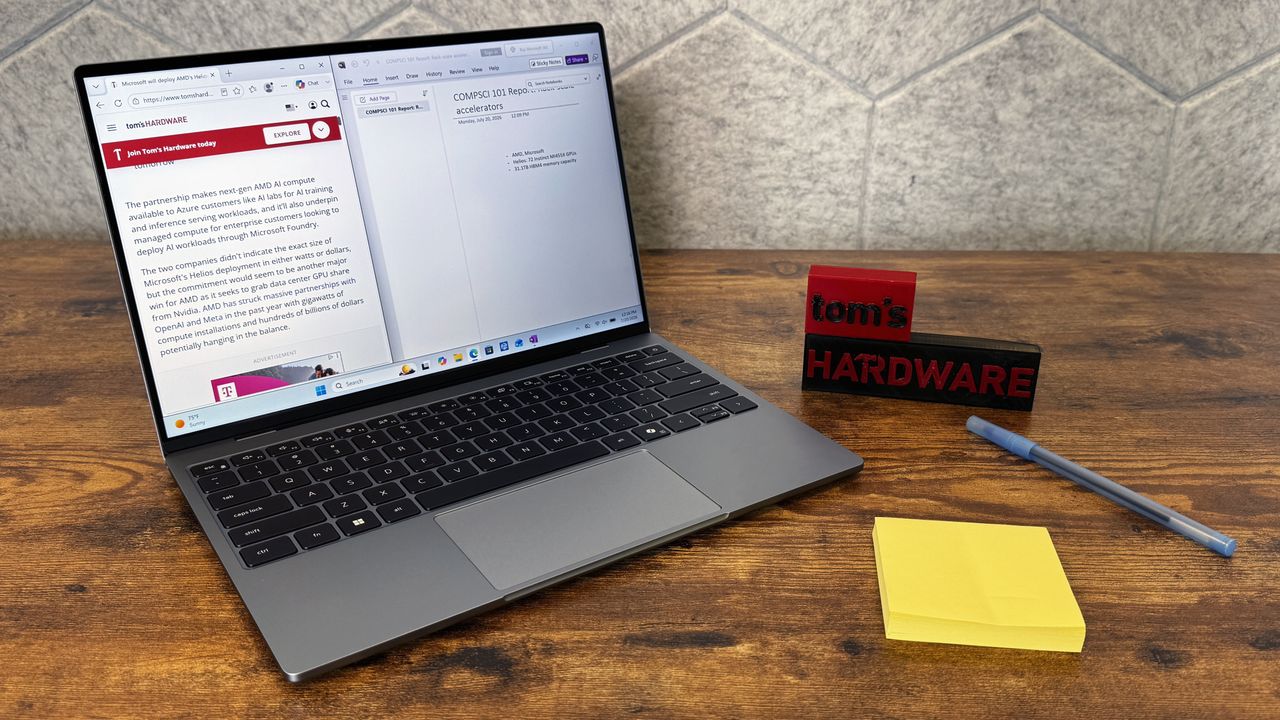
The Dell XPS 13 returns as an excellent Windows-based answer to the MacBook Neo. It’s no performance powerhouse, but at just 2.2 pounds, with 8GB and 16GB options and nearly 15 hours of battery life in our testing, it’s an excellent option for students or mainstream users who don’t need more CPU or GPU muscle.
Why you can trust Tom's Hardware
Our expert reviewers spend hours testing and comparing products and services so you can choose the best for you. Find out more about how we test.
A year after killing off its long-running XPS premium consumer brand, Dell did an about-face at CES early this year, promising new models, including the redesigned XPS 13 we’re looking at here. But between Dell’s announcement and the XPS 13’s launch, Apple stunned the portable PC world with its budget-priced, unquestionably pretty MacBook Neo, at a starting price of $599 (which got bumped up to $699 in June), leaving even Windows die-hards wondering how PC makers were going to compete in the budget and mid-range laptop space.
Dell clearly decided the XPS 13 was its answer to the Neo, giving it a starting price of $699 for the model with 8GB of RAM (comparable to the Neo), or $899 for the 16GB model. Both options sport the same 512GB of SSD storage and an Intel Series 3 Core 5 320 (Wildcat Lake) CPU. We tested both the 8GB and 16GB models, though there is little difference outside of memory capacity.
The XPS 13 may lack the design flourishes of previous XPS models (there is no carbon fiber to be found), but if I had to describe the new XPS 13’s look in one word, it would be “refined.” Available in the silver “sky” color of our review unit, or a darker gray “storm” hue, all the edges are rounded, and the all-aluminum chassis feels premium, with only some slight flex. And I like the understated branding, with a slim, mirrored XPS logo on top and a smaller mirrored Dell logo underneath.
It’s a look that generally doesn’t stray far from the Apple laptop standard, but the XPS 13 actually feels better in the hands than the MacBook Neo. At 11.69 x 7.9 x 0.5 inches, the Dell’s dimensions roughly match the Neo (11.71 x 8.12 x 0.5 inches), but the XPS is a half-pound lighter (2.2 pounds for the Dell versus 2.7 pounds for the Apple), and Dell tapers its edges more, making it feel slimmer. Both are attractive laptops, to be sure, but having held them both side-by-side, I slightly prefer the XPS 13. And considering how much the MacBook Neo wowed the consumer tech world earlier this year, that’s an impressive achievement from Dell.
Port selection is relegated to a single USB-C port on either side. But with the XPS 13, both are 10 Gbps ports that support DisplayPort 2.1 and charging, while Apple’s competition has one 10 Gbps port and one much slower USB 2.0 port (both are USB-C). Apple does include a headphone jack, which the XPS 13 lacks, and that will be annoying for some. But Dell includes a keyboard backlight while Apple leaves your fingers to fumble around in the dark. Personally, I’d take a backlight over an audio jack any day.
The only thing I don’t love about the new XPS 13’s design is the somewhat sharp edge of metal at the bottom rear, behind the exhaust vents. Because the laptop is so slim and light, I found myself grabbing it by any and all angles, and this is the one area where it doesn’t feel premium or comfortable to hold.
We tested both the 8GB and 16GB variants of the XPS 13. Aside from RAM capacity, the two machines share the same Intel “Wildcat Lake” Series 3 Core 5 320 CPU, with two Performance cores that can Turbo up to 4.6 GHz and four Efficient cores that can hit 3.4 GHz.
Get Tom's Hardware's best news and in-depth reviews, straight to your inbox.